When a good mesh gives the wrong answer: OpenFOAM vs code_saturne on the backward-facing step
About 95 RANS simulations of the NASA backward-facing step in OpenFOAM and code_saturne: which mesh defects break convergence, and what limiters really do.

About 95 RANS simulations of the NASA backward-facing step in OpenFOAM and code_saturne: which mesh defects break convergence, and what limiters really do.
Every fire engineer who designs a stair pressurization system ends up asking the same question: is a multizone airflow network enough, or do I need CFD? CONTAM, NIST’s multizone airflow and contaminant transport code, solves a whole building in Read more
We ran the Steckler room fire (Test 14) in FDS and OpenFOAM 14 on the same grid, with a volumetric heat source and a passive soot scalar in OpenFOAM: temperatures, door flows, soot density, visibility and cost.
We ran the classic dam break with an obstacle in OpenFOAM 14, OpenFOAM v2606 (with AMR) and DualSPHysics on cloudHPC: how close VOF and SPH come on the same geometry, against the experiment, and what each run cost.
OpenLB is an open-source lattice Boltzmann (LBM) framework written in C++. It is used for flows that are awkward for classical finite-volume codes: complex geometries, porous media, particle-laden and multiphysics problems. Because the lattice Boltzmann method is local and Read more
Elmer FEM is an open-source finite element code from CSC (Finland) that many engineers use for heat transfer, structures, electromagnetics and fluids. Before trusting any solver for real work, it is worth asking a simple question: does it solve Read more
Short version. We built a 20.7-million-cell large-eddy simulation (LES) of the flow past a circular cylinder at Re = 3900, ran it with code_saturne 9.0.1 on six cloudHPC configurations (32, 48 and 96 cores on hypercore; 32, 48 and Read more
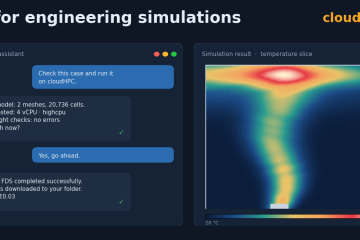
FDS, OpenFOAM, code_aster, EnergyPlus, OpenRadioss and more: describe what you need in plain language, and your AI assistant prepares, checks, launches and analyses the simulation on cloudHPC. Running a simulation in the cloud has always meant many small technical Read more
The classic design loop in CFD goes like this: guess a shape, mesh it, simulate it, look at the result, tweak the geometry, repeat. It works when a design has three or four parameters. It stops working when the Read more
Some flows don’t cooperate with a mesh. A wave breaking over a seawall, a dam failing catastrophically, debris tumbling through floodwater, a tank sloshing under motion โ these are all problems where the free surface fragments, merges, and moves Read more