ELMFIRE vs FDS: two level-set wildfire models, three tests, one satellite footprint
TL;DR
- Same physics, same answer on flat ground. ELMFIRE 1.1 and the FDS 6.11.2 level set (mode 1) both use Rothermel’s spread rate and Anderson’s ellipse. On flat terrain their 30-minute fronts land within 1 % of the closed-form head position.
- Slope is where they part. On a 20° slope, FDS gets the upslope head right but the fire is about 40 % too narrow. Downslope, FDS ignores the slope and runs 58 % too far. ELMFIRE stays within about 15 % of the reference in every direction.
- Both underpredict the CSIRO grass fires by 30–60 %: the measured C064 head reached 100 m in 100 s, the models 43 m. The gap comes from the Rothermel spread rate both codes share, not from the level-set solvers: they agree within 4 m.
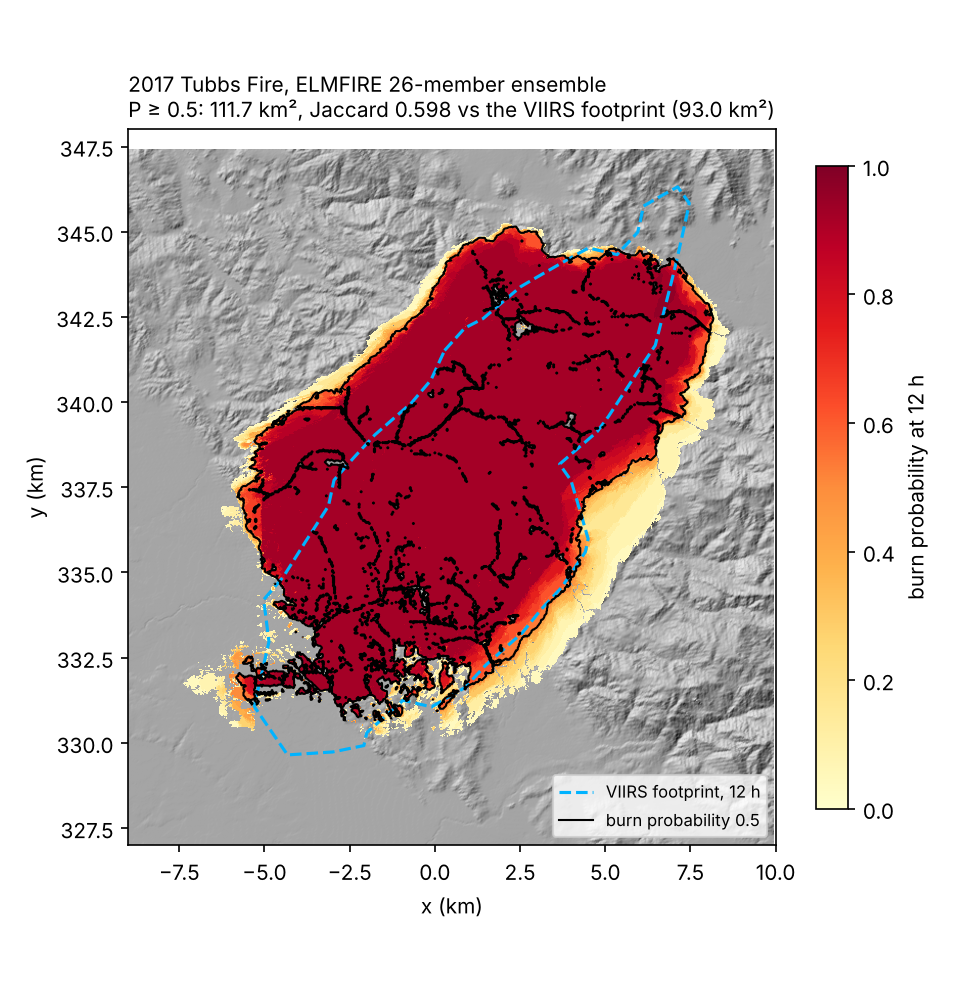
- On the 2017 Tubbs Fire the fire-spread mechanisms matter more than the solver. FDS and an FDS-equivalent ELMFIRE run burn 49 and 43 km², against 93 km² in the satellite footprint. Fuel models and canopy wind sheltering each change the area by a factor of 2–4. Ember spotting brings the overlap with the satellite footprint (Jaccard) up to 0.54, and a 26-member ELMFIRE ensemble to 0.60.
- Run time: the 12-hour Tubbs Fire took 18 minutes of FDS on 96 cores (€4.88) and 6–73 seconds of ELMFIRE on 4 cores. Switching on ELMFIRE’s building-to-building spread makes it hundreds to thousands of times slower: 10 to more than 50 hours per run.
Why compare ELMFIRE and FDS
FDS is the fire model most of our users run on cloudHPC, and its level-set mode is the quick way to put a wildfire into an FDS terrain model (see our earlier wildfire post with Chimney Tops 2 and the FDS level-set modes). ELMFIRE is a wildfire model written from the start for landscapes: Monte Carlo ensembles, crown fire, ember spotting and building-to-building spread. It is used for operational fire-spread forecasting in the US.
Both codes advance a level-set front with the Rothermel (1972) spread rate, so on paper they should agree. We tested that on three cases of increasing size and realism:
- Elliptical spread (verification): a point ignition on flat ground and on a 20° slope, compared with the closed-form Rothermel + Anderson ellipse.
- CSIRO grassland fires C064 and F19 (validation): two field experiments from the FDS Validation Guide, with measured head-fire positions.
- 2017 Tubbs Fire (landscape validation): the first 12 hours on a 21 × 27 km landscape, compared with the VIIRS satellite active-fire footprint used by the ELMFIRE V&V suite.
Results at a glance
| Case | Metric | Reference | FDS 6.11.2 level set | ELMFIRE 1.1 |
|---|---|---|---|---|
| 1 Flat | head position at 30 min | 627 m (closed form) | 630 m (+0.4 %) | 625 m (−0.4 %) |
| 1 Upslope 20° | burned area at 30 min | 42.2 ha | 24.0 ha (−43 %) | 43.9 ha (+4 %) |
| 1 Downslope 20° | head position at 30 min | 374 m | 590 m (+58 %) | 375 m (+0.3 %) |
| 1 Cross-slope 20° | burned area at 30 min | 31.7 ha | 20.6 ha (−35 %) | 28.3 ha (−11 %) |
| 2 C064 | head position at 100 s | 100 m (measured) | 43 m (modes 1 and 4) | 43.5 m |
| 2 F19 | head position at 138 s | 200 m (measured) | 118 m (mode 1), 138 m (mode 4) | 116.5 m |
| 3 Tubbs, FDS-equivalent | Jaccard vs VIIRS at 12 h | 93.0 km² footprint | 0.27 (49.4 km²) | 0.29 (43.2 km²) |
| 3 Tubbs, full ELMFIRE | Jaccard vs VIIRS at 12 h | 93.0 km² footprint | n/a | 0.54 (embers) / 0.60 (26-member ensemble, P ≥ 0.5) |
How the runs were set up
- Solvers: FDS 6.11.2 with
LEVEL_SET_MODE=1(uncoupled level set: the wind field is not affected by the fire) and, for the CSIRO cases, alsoLEVEL_SET_MODE=4(the level set coupled to the LES flow). ELMFIRE 1.1. Both are installed apps on cloudHPC. - Common ground: Anderson’s 13 fuel models, wind given at 6.1 m (20 ft) and reduced to midflame with the same wind adjustment factor, and Anderson’s length-to-breadth ratio (L/B = 0.936 e^(0.2566 U) + 0.461 e^(−0.1548 U) − 0.397, with U the midflame wind in m/s). These are the choices that make the two codes comparable. Everything ELMFIRE adds on top (Scott & Burgan 40 fuels, canopy sheltering, crown fire, spotting, buildings) is switched on step by step in case 3.
- Instances: FDS and ELMFIRE on hypercore spot instances, except the single ELMFIRE run with building spread, which ran on a regular instance. The ensemble also ran on spot: we expected it to take hours, it took over two days, and it was never pre-empted.
- Our own reference: a short Python Rothermel implementation for the closed-form ellipse of case 1 (in the
cases/folder of the download).
Case 1: elliptical spread on flat and sloped ground

Set-up. A 1.2 × 0.6 km plane with 10 m cells, Anderson fuel model 1 (short grass), dead fuel moisture 6/7/8 %, a 5 m/s wind from the west at 6.1 m, and a point ignition, run for 30 minutes. Four terrains: flat, and a 20° slope with the wind blowing upslope, downslope and across the slope. The reference is the Rothermel spread rate with the slope factor, combined with the wind as a vector, and Anderson’s ellipse. On flat ground this gives a head-fire rate of spread of 0.348 m/s and L/B = 1.44.
| Terrain | Front at 30 min | Closed form | FDS | ELMFIRE |
|---|---|---|---|---|
| Flat | head / back (m) | 627 / −102 | 630 / −100 | 625 / −105 |
| Flat | area (ha) | 29.0 | 29.9 | 30.1 |
| Upslope 20° | head / width (m) | 805 / 589 | 810 / 350 | 805 / 550 |
| Upslope 20° | area (ha) | 42.2 | 24.0 | 43.9 |
| Downslope 20° | head (m) | 374 | 590 | 375 |
| Downslope 20° | area (ha) | 12.1 | 28.1 | 13.6 |
| Cross-slope 20° | area (ha) | 31.7 | 20.6 | 28.3 |


What we learned.
- On flat ground the two codes are the same model: fronts overlap, and the heads are within 1 % of the closed form. The 3–4 % excess in area comes from the 10 m grid smoothing the ellipse.
- On a slope, FDS treats terrain differently. In
vege.f90(line 439 in FDS 6.11.2, still there in the source of 25 November 2026), the size of the slope factor is computed asSQRT(PHI_S_X+PHI_S_Y): the square root of the sum of the signed components, not of their squares. When the terrain gradient points towards −x or −y, as in our downslope case with the wind from the west, the sum is negative, the square root is undefined, the slope term is skipped, and FDS spreads the fire as if the ground were flat (590 m vs 374 m). Upslope, wind and slope are added FARSITE-style into a single effective wind, which keeps the head right but makes the ellipse too narrow (350 m wide instead of 589 m). - ELMFIRE combines wind and slope as vectors and stays within about 15 % of the reference in all four terrains. In the upslope and cross-slope runs the flanks reach the edge of the domain at 30 min (ELMFIRE at ±275 m, FDS at +300 m), so the ELMFIRE width there (550 m) and both codes’ areas are slight underestimates; in the cross-slope case the closed-form ellipse itself runs past the domain edge.
- This matters for any FDS level-set model on real terrain: downslope runs and flanks will be off. It is worth an issue on the FDS repository.
Case 2: CSIRO grassland fires C064 and F19

Set-up. The inputs are the FDS 6.11.2 validation-suite files for the CSIRO experiments of Cheney et al. (1993). C064 is a 100 × 100 m plot of short grass (Anderson fuel model 1), 6.3 % moisture, 4.6 m/s wind at 2 m. F19 is a 200 × 200 m plot of tall grass (fuel model 3), 5.8 % moisture, 4.9 m/s wind. The ignition line is lit by walking crews, as in the FDS input. FDS runs with 5 m cells in mode 4 (coupled) and mode 1 (uncoupled). ELMFIRE runs on 1 m cells, with the 2 m wind converted to 6.1 m using the FDS log profile and the roads around the plot set as non-burnable.
| Head-fire position | C064 at 27 / 53 / 100 s | F19 at 56 / 86 / 138 s |
|---|---|---|
| Measured | 15 / 42 / 100 m | 80 / 120 / 200 m |
| FDS mode 4 (coupled) | 13 / 23 / 43 m | 54 / 82 / 138 m |
| FDS mode 1 (uncoupled) | 9 / 23 / 43 m | 42 / 74 / 118 m |
| ELMFIRE 1.1 | 10.5 / 22.5 / 43.5 m | 45.5 / 72.5 / 116.5 m |

What we learned.
- With the same physics (FDS mode 1 vs ELMFIRE), the two codes agree within 4 m at every measured time. The steps in the FDS curves come from its 5 m cells.
- Both underpredict the measured spread, by 30–60 % at the last measured time. That is the Rothermel model on these grasses, not the solvers, and it matches the FDS Validation Guide. The coupled FDS mode 4 helps on F19 (138 m against 118 m) because the fire draws in air and tilts the flame. It costs 10–35 times more wall time, still under 30 s at this size.
- The measured fire is much wider and blunter than either model’s ellipse (right-hand panels).
Case 3: the 2017 Tubbs Fire, first 12 hours

Set-up. We used the inputs of the Tubbs Fire validation case in the ELMFIRE V&V suite: a 21 × 27 km landscape at 30 m resolution (700 × 900 cells) north of Santa Rosa, California, with LANDFIRE fuels, canopy and building rasters. There are 25 half-hourly weather rasters starting at 21:45 PDT on 8 October 2017. The first 7 hours are a strong north-east Diablo wind, about 14 m/s domain median at 6.1 m. The reference is the concave hull of the VIIRS active-fire detections up to 12 hours after ignition (93.0 km²), the metric used in the V&V suite. The scores are Jaccard (overlap divided by union), precision and recall.
To separate solver from physics, we built a ladder of ELMFIRE runs that starts as close to FDS as possible and adds one mechanism at a time. FDS runs the first rung:
- FDS-equivalent: Scott & Burgan fuels mapped to Anderson 13 (our crosswalk), domain-median wind (uniform in space), no canopy sheltering, crown fire, spotting or buildings. In FDS, the terrain is a 30 m triangulated surface with a fuel model per face, using 63 meshes (17.6 M cells).
- + canopy wind sheltering: ELMFIRE’s default wind adjustment factor under the canopy.
- + spatial wind and moisture: the full weather rasters.
- + Scott & Burgan 40 fuels: native fuel models instead of the Anderson crosswalk.
-
+ crown fire.
-
+ ember spotting.
-
+ building-to-building spread (the full deterministic model).
- Ensemble: the full model with random perturbations of wind speed and direction (±5 mph, ±7.5°), fuel moisture and spread-rate adjustment, as in the V&V case. It gives a burn-probability map, which is scored at a probability of 0.5. We launched 32 members and stopped the job after 52 hours with 26 finished (see Run times and costs).
| Run (12 h) | Burned area (km²) | Jaccard | Precision | Recall |
|---|---|---|---|---|
| VIIRS footprint | 93.0 | – | – | – |
| FDS 6.11.2 level set (mode 1) | 49.4 | 0.27 | 0.62 | 0.33 |
| ELMFIRE FDS-equivalent | 43.2 | 0.29 | 0.70 | 0.33 |
| + canopy wind sheltering | 18.9 | 0.12 | 0.61 | 0.12 |
| + spatial wind & moisture | 22.9 | 0.14 | 0.63 | 0.16 |
| + Scott & Burgan 40 fuels | 6.1 | 0.04 | 0.66 | 0.04 |
| + crown fire | 16.4 | 0.12 | 0.72 | 0.13 |
| + ember spotting | 103.8 | 0.54 | 0.66 | 0.74 |
| + building spread | not finished after 56 h (stopped) | – | – | – |
| Ensemble (26 members), P ≥ 0.5 | 111.7 | 0.60 | 0.69 | 0.82 |
| ELMFIRE V&V reference, 50 members | 133.8 | 0.56 | 0.61 | 0.87 |


What we learned.
- The solvers agree. On the same inputs, FDS and ELMFIRE burn 49 and 43 km² with nearly the same shape. Their growth curves overlap for 8 hours, so the level-set numerics are not the issue on a landscape either.
- The inputs dominate. Canopy sheltering alone cuts the burned area from 43 to 19 km². Swapping our Anderson crosswalk for the native Scott & Burgan fuels cuts it again to 6 km², because many grass-shrub models spread much more slowly at this moisture. Each choice moves the answer by a factor of 2–4, more than anything in the solver.
- The Tubbs Fire was an ember-driven fire. Without spotting, no run covers more than a third of the observed footprint in 12 hours. With spotting, ELMFIRE burns 104 km² and covers 74 % of the observed footprint. The Jaccard of 0.54 is close to the 0.56 of the V&V suite’s 50-member reference. FDS’s level set has no spotting model, so it cannot get there.
- Building spread is the expensive part. Every run without it took 6 to 73 seconds of wall time on 4 cores, embers included. The same run with building-to-building spread had not finished after 56 hours, and the ensemble members that did finish took 10 to 42 hours each (median about 20 h). That is a factor of hundreds to thousands for one switch, so the burned area with buildings comes from the ensemble, not from a single run.
- Ensembles are what ELMFIRE is for. The 26-member ensemble gives the best match of the study: a Jaccard of 0.60 and 82 % of the observed footprint inside the 50 % contour, on a par with the V&V suite’s 50-member reference (0.56). The members agree on the core of the fire (24 of 26 burn 99–126 km²); the uncertainty sits on the flanks and the southern urban edge. Two members went out within about an hour of ignition, a reminder that a single deterministic run can be an unlucky draw.
Run times and costs
| Job | Instance | Wall time | Cost |
|---|---|---|---|
| ELMFIRE app check + cases 1–2 (6 ELMFIRE and 8 FDS runs) | hypercore spot, 2–4 vCPU | seconds to minutes each | under €1 in total |
| Tubbs, FDS mode 1 (63 meshes, 17.6 M cells, 12 h) | 96 vCPU hypercore spot | 18 min (1,095 s) | €4.88 |
| Tubbs, FDS first attempt, out of memory | 64 vCPU highcore spot | – | €0.53 |
| Tubbs, ELMFIRE ladder job: 5 runs without buildings + 1 with building spread (stopped) | 4 vCPU hypercore, regular | 6–73 s each; 56.7 h for the run with buildings | €49.89 |
| Tubbs, ELMFIRE embers run (rerun) and FDS-equivalent run | 4 vCPU hypercore spot | about 1 min each | under €0.10 |
| Tubbs, ELMFIRE ensemble (26 of 32 members done, then stopped) | 32 vCPU hypercore spot | 52.6 h | €185.20 |
FDS needed about 14 kB of RAM per cell with the terrain and level set (247 GB peak for 17.6 M cells). The first attempt on 64 highcore cores (128 GB) ran out of memory. ELMFIRE runs one ensemble member per MPI process, so when its members end at different times the machine idles until the slowest one finishes. In our ensemble, 25 members finished within about 33 hours, the 26th at 42 hours, and 6 were still running after 52 hours, so most of the 32 cores sat idle for the last day. With building spread on, set a time limit (MAX_RUNTIME) and use fewer, longer-running cores, or run the ensemble in smaller batches.
How to run these cases on cloudHPC
FDS level set
- Use
LEVEL_SET_MODE=1for fire spread only. SetDTandLOCK_TIME_STEP=.TRUE.on&TIME, otherwise the time step stays at its small initial value. We usedDT=2on 30 m cells. - Large terrains: plan about 14 kB per cell. For the 17.6 M-cell Tubbs case use 96 hypercore or highmem instances.
- Spot instances are fine. Add
DT_RESTARTto&DUMPand cloudHPC restarts the job automatically after a pre-emption.
ELMFIRE
- Upload the folder with
inputs/elmfire.data. The app picks the cores and runsmpirunfor you. - Set
CLEAN_SCRATCH = .TRUE.in&SIMULATOR. ELMFIRE otherwise leaves thousands of scratch files, which slows down the storage upload. - If spotting is on, the building rasters (
BLDG_AREA_FILENAMEand the others) must stay in&INPUTSeven with building spread off. Otherwise ELMFIRE stops looking for./inputs/.tif. - Outputs (
time_of_arrival_*.tifand others) are written only when each run ends. Use sync on a running job to see which ensemble members are done. - Building spread and ensembles can run for many hours. Use regular instances for long single runs, and keep the number of ensemble members a multiple of the vCPUs.
FAQ
Is ELMFIRE better than FDS for wildfires?
For landscape fire spread, yes. It has crown fire, ember spotting, building spread, spatially varying weather and Monte Carlo ensembles, and on flat ground it gives the same answer as FDS. FDS is the right tool when you need the fire’s effect on smoke, flow and structures in a 3D CFD model, or a fire coupled to the atmosphere (level-set modes 2–4).
Do FDS and ELMFIRE use the same fire-spread model?
Both use Rothermel’s surface spread rate, Anderson’s ellipse and the same wind adjustment factor. On flat ground they agree within 1 %. They differ in how they combine wind and slope, and ELMFIRE adds crown fire, spotting and building spread.
Why does FDS overpredict downslope fire spread?
In FDS 6.11.2 the slope factor’s magnitude is computed from the sum of its signed components (SQRT(PHI_S_X+PHI_S_Y) in vege.f90). When the terrain gradient points towards −x or −y the sum is negative, the square root is undefined and the slope effect is skipped, so a fire running downhill spreads as on flat ground.
How long does an ELMFIRE run take?
Seconds for the small cases, and 6 to 73 seconds on 4 cores for the 12-hour Tubbs Fire without buildings, against 18 minutes of FDS on 96 cores. With building-to-building spread, a single 12-hour run had not finished after 56 hours. In our ensemble on 32 cores, finished members took 10 to 42 hours (median about 20 h); we stopped the job after 52 hours with 26 of 32 finished.
How accurate is a level-set model on a real wildfire?
On the Tubbs Fire the best single ELMFIRE run overlapped the satellite footprint with a Jaccard of 0.54, and the 26-member ensemble’s 50 % contour 0.60. The uncertainty in fuels, canopy and wind is larger than the solver error. That is why operational tools run ensembles and report probabilities.
References
- Rothermel, R.C. (1972). A mathematical model for predicting fire spread in wildland fuels. USDA Forest Service Research Paper INT-115.
- Anderson, H.E. (1983). Predicting wind-driven wild land fire size and shape. USDA Forest Service Research Paper INT-305.
- Anderson, H.E. (1982). Aids to determining fuel models for estimating fire behavior. USDA Forest Service General Technical Report INT-122.
- Scott, J.H. and Burgan, R.E. (2005). Standard fire behavior fuel models: a comprehensive set for use with Rothermel’s surface fire spread model. USDA Forest Service General Technical Report RMRS-GTR-153.
- Cheney, N.P., Gould, J.S. and Catchpole, W.R. (1993). The influence of fuel, weather and fire shape variables on fire-spread in grasslands. International Journal of Wildland Fire 3(1), 31–44. https://doi.org/10.1071/WF9930031
- Lautenberger, C. (2013). Wildland fire modeling with an Eulerian level set method and automated calibration. Fire Safety Journal 62, 289–298. https://doi.org/10.1016/j.firesaf.2013.08.014
- Bova, A.S., Mell, W.E. and Hoffman, C.M. (2016). A comparison of level set and marker methods for the simulation of wildland fire front propagation. International Journal of Wildland Fire 25(2), 229–241. https://doi.org/10.1071/WF13178
- Our earlier post: Wildfire simulation with FDS: the Chimney Tops 2 fire and the four level-set modes. https://cloudhpc.cloud/2026/11/13/fds-wildfire-level-set-chimney-tops-2/
- McGrattan, K. et al. Fire Dynamics Simulator User’s Guide and Validation Guide, NIST Special Publications 1019 and 1018-3, FDS 6.11.2. https://pages.nist.gov/fds-smv/manuals.html
- FDS source code,
Source/vege.f90. https://github.com/firemodels/fds - ELMFIRE source code and V&V suite (Tubbs Fire case). https://github.com/lautenberger/elmfire
- NASA FIRMS, VIIRS active fire detections. https://firms.modaps.eosdis.nasa.gov/
CloudHPC is a HPC provider to run engineering simulations on the cloud. CloudHPC provides from 1 to 224 vCPUs for each process in several configuration of HPC infrastructure - both multi-thread and multi-core. Current software ranges includes several CAE, CFD, FEA, FEM software among which OpenFOAM, FDS, Blender and several others.
New users benefit of a FREE trial of 300 vCPU/Hours to be used on the platform in order to test the platform, all each features and verify if it is suitable for their needs