
Code Aster preCICE
FSI for code_aster: our new open-source preCICE connector, presented at AsterLab
Recap of our AsterLab webinar: precice_aster, the new open-source preCICE connector for two-way FSI and CHT between code_aster and OpenFOAM.
Recap of our AsterLab webinar: precice_aster, the new open-source preCICE connector for two-way FSI and CHT between code_aster and OpenFOAM.
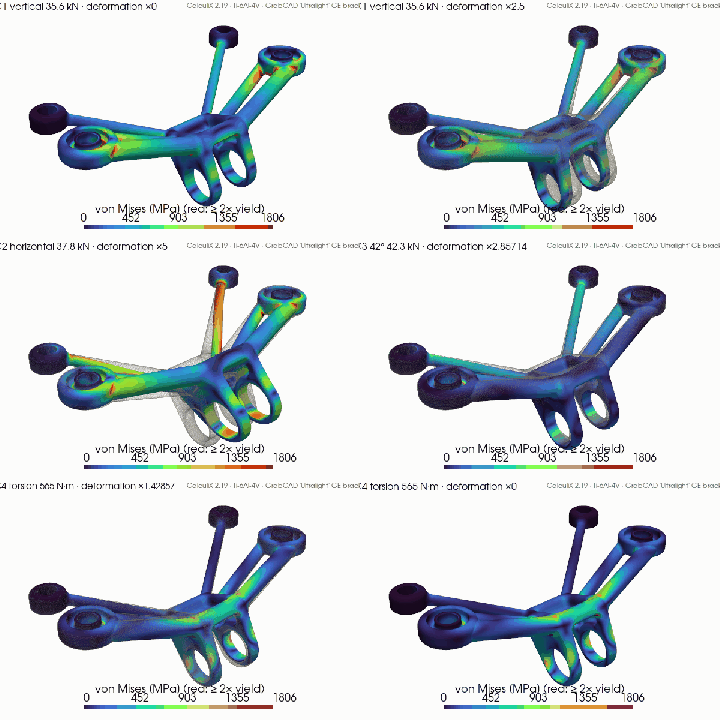
Why this bracket, and why now In 2013 GE Aviation and GrabCAD asked the community to make an engine-lifting bracket lighter for additive manufacturing. The bracket had to keep its four bolt interfaces and its clevis pin, and it had to carry four static loads. GE’s own write-up of the Read more

Expansion-chamber muffler transmission loss from Elmer, code_aster, FEniCSx and FreeFEM on cloudHPC: same mesh, same answer, where 1D theory fails.

TL;DR Why this case In October we released precice_aster, a GPL-3.0 connector that couples code_aster to OpenFOAM, CalculiX and any other preCICE participant, for both fluid–structure interaction (FSI) and conjugate heat transfer. We presented it in a webinar with AsterLab and validated it on the preCICE tutorials: the perpendicular flap, Read more

We ran four structural problems with code_aster and OpenCourant on cloudHPC. Impact and crash belong to OpenCourant, static and creep to code_aster, and the error messages show why.

In complex mechanical simulations, maintaining an accurate mesh throughout a non-linear evolution is critical. This guide explores how to implement automatic mesh adaptation using the MACR_ADAP_MAIL macro in code_aster, specifically for cases involving the STAT_NON_LINE solver. 1. Overview of the Adaptation Strategy The goal is to iteratively refine or derefine Read more

Structural stability is paramount in design. While static analysis helps us understand stress and deformation, it doesn’t always tell the whole story. A slender column, perfectly safe under a static load, can suddenly collapse due to buckling when that load reaches a critical point. This phenomenon is a catastrophic failure Read more

In the demanding world of Finite Element Analysis (FEA), performance is king. When tackling complex engineering problems, especially with large datasets and intricate geometries, how efficiently your software scales with increasing computational resources can make or break your analysis time. This is precisely what we set out to investigate: a Read more

Finite Element Analysis (FEA) is a powerful tool for understanding the structural behavior of complex designs. In this post, we’ll delve into an FEA analysis performed on a drone frame using the open-source software Code_Aster. Our goal was to analyze its static and dynamic characteristics, and we leveraged the power Read more

The oil and gas, petrochemical, and power generation industries heavily rely on aging infrastructure operating under demanding conditions. Ensuring the integrity of these assets is paramount, and API 579-1/ASME Fitness-For-Service (FFS) provides a robust framework for evaluating the structural integrity of in-service components with flaws. Finite Element Analysis (FEA) is Read more