A full car fire under a steel car-park frame: FDS + CalculiX coupled with preCICE on cloudHPC
Full car fire under a steel car-park frame with FDS 6.11.1, preCICE 3.3.1 and CalculiX 2.20 on cloudHPC: steel at 755 ยฐC, 34 mm deflection, โฌ16.
Why couple FDS to a structural solver? FDS is the most used fire model in performance-based fire engineering. Its solid-phase heat transfer is mostly one-dimensional through each wall cell (a 3-D option exists for simple obstructions). It has no mechanics at all. When the question becomes “how hot does this Read more
We converted FDS inputs to CFAST automatically and compared CFAST, FDS 6.11.1 and experiments on 6 fire cases. Results, limits and speed-up.
How to model a jet fan that is not aligned with the FDS grid: louvered UVW vents vs a rotated GEOM fan, tested on cloudHPC with 5 LES runs, jet angles and costs.
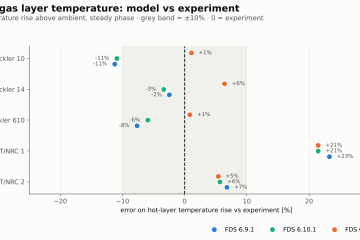
We ran seven FDS Validation Guide cases with FDS 6.9.1, 6.10.1 and 6.11.1 on cloudHPC. 6.11.1 predicts hotter small-room layers and cooler flames; large-compartment results do not change.
Every fire engineer who designs a stair pressurization system ends up asking the same question: is a multizone airflow network enough, or do I need CFD? CONTAM, NIST’s multizone airflow and contaminant transport code, solves a whole building in seconds. FDS, NIST’s Fire Dynamics Simulator, resolves the flow in three Read more
We ran the Steckler room fire (Test 14) in FDS and OpenFOAM 14 on the same grid, with a volumetric heat source and a passive soot scalar in OpenFOAM: temperatures, door flows, soot density, visibility and cost.
Fire Dynamics Simulator (FDS) has been the standard CFD tool for fire and smoke modeling for two decades โ and for just as long, its pressure solve has been a CPU-bound bottleneck on large domains. FireX, NIST’s experimental GPU-accelerated development branch of FDS, is the first serious attempt to change Read more
The prediction of wildfire behavior is a critical challenge for fire safety engineers and environmental scientists. While the Fire Dynamics Simulator (FDS) is traditionally known for indoor fire modeling, its capabilities for large-scale wildland scenarios have expanded significantly. By combining geospatial data, advanced numerical methods, and the power of cloud Read more
Fires aren’t all created equal. In the world of fire protection engineering, understanding the nature of the fuel is the first step toward stopping it. This is where ISO 3941 comes inโitโs the international standard that categorizes fires into classes based on the fuel source. But what if you aren’t Read more