FEM cloud structure analysis

Structural FEM analysis in the cloud with CalculiX and code_aster
Set up your model in PrePoMax or Salome-Meca on a remote desktop, or upload your input files, and run them on machines with the cores and the memory a large non-linear model needs. Parallel builds are already installed. You pay only while the machine runs.

Two open-source FEM codes, built for speed
The standard builds of CalculiX and code_aster run on one core. On cloudHPC they come compiled with parallel solvers, so large models finish in a fraction of the time.
CalculiX
- Versions from 2.18 to the latest
- PARDISO direct solver, multi-threaded on all cores; an MPI build is also available
- Upload the
.inpdeck:*INCLUDEfiles can stay alongside - Native
.frdand.datoutputs, ready for PrePoMax or CalculiX GraphiX
code_aster
- Versions from 17.0 to the latest, compiled with MPI and PETSc
- Upload the
.export, the.command the.medmesh: paths from your PC are fixed automatically - Memory, time limits and OpenMP threads set from the machine you choose
- The same build couples with OpenFOAM through preCICE for FSI and CHT
Elmer
Open-source multiphysics FEM: heat transfer, electromagnetics, acoustics and structural mechanics, with ElmerGUI on the remote desktop.
FEniCSx and FreeFEM
Write your own weak forms in Python or in the FreeFEM language, for research and non-standard physics.
OpenCourant
Explicit dynamics for crash, impact and drop tests, the successor of OpenRadioss. Learn more
From a linear static check to fracture mechanics
Linear and non-linear
- Non-linear materials: plasticity, orthotropic and composite materials
- Non-linear geometry: large displacements and rotations
- Contact between parts
Analysis types, alone or combined
- Static, dynamic, modal and harmonic
- Thermal and thermo-mechanical
- Fatigue and fracture mechanics
Fracture mechanics
Crack propagation and stress intensity factors are among the most memory-hungry analyses: on cloudHPC you can choose up to 8 GB of RAM per vCPU and run several crack configurations at the same time.

Set up the model in the cloud, too
Start a remote desktop in your browser and prepare the model where it will run: no local install and no file transfers.
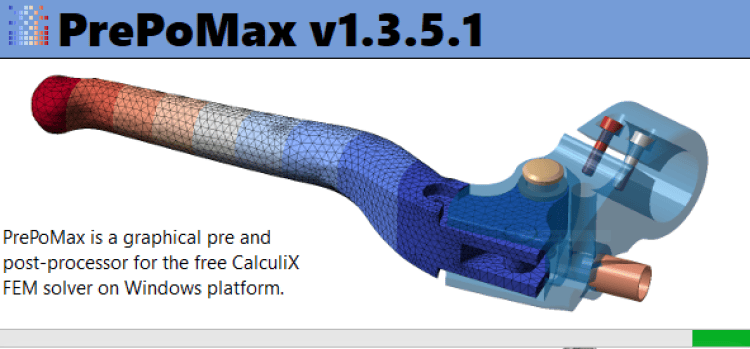
PrePoMax CalculiX
- Imports STEP and IGES CAD
- Meshes with Netgen and sets up the CalculiX analysis
- Reads the results back for post-processing
Salome-Meca code_aster
- Creates or imports CAD in STEP and IGES
- Structured, unstructured and body-fitted meshing
- Sets up code_aster studies and post-processes them in ParaVis, based on ParaView
How many vCPU does my model need?
CalculiX
- Set
SOLVER=PARDISOon*STATIC - PARDISO scales up to about 200,000 nodes per core
- Start on highcpu; move to standard, then highmem, only after a memory error
code_aster
- Plan at least ~100,000 nodes per MPI process
- Select at least twice the
mpi_nbcpuof the .export in vCPU - Memory hungry: start on highcpu and move up only if needed
More details in the CalculiX and code_aster scalability guides.
FEM without the IT work
Many scenarios at once
Load cases, materials or design variants on separate machines, all running at the same time.
Pay per use
No subscription and no licence: you pay per vCPU hour, only while the machine runs. Check the cost with the price calculator.
Training and support
Our engineers use these solvers on real projects and can help you set up and debug your models. Automate everything with the cloudHPC API.
Your first FEM run in five steps
- Register on cloudHPC and activate your account.
- Prepare the model locally or on a remote desktop with PrePoMax or Salome-Meca.
- Upload the input files to a storage folder.
- Choose the solver version and the machine, and launch.
- Post-process on the remote desktop, or download the results.
Run your next FEM model in the cloud
Create your account and get 300 free vCPU hours to try CalculiX and code_aster on your own models.