CONTAM vs FDS for Stair Pressurization: Lessons from a 10-Storey Fire Tower
Every fire engineer who designs a stair pressurization system ends up asking the same question: is a multizone airflow network enough, or do I need CFD?
CONTAM, NIST’s multizone airflow and contaminant transport code, solves a whole building in seconds. FDS, NIST’s Fire Dynamics Simulator, resolves the flow in three dimensions but needs a mesh, a cluster and hours instead of seconds. Both are free and both are widely used for smoke control, often for the same job.
To see where each one stands, we modelled the same building with both codes and checked them against real measurements: the 10-storey experimental fire tower of the National Research Council of Canada (NRC), where Tamura, Klote and co-workers ran a long series of stair and elevator pressurization tests and published the leakage areas, supply rates and measured pressure differences.
The test case: the NRC fire tower
The tower reproduces the core of a high-rise building: a stair shaft, an elevator shaft, a service shaft and ten floors, each with known leakage areas through exterior walls, stair doors, elevator doors, floors and shafts. Floor heights are 3.6 m for the first two floors and 2.6 m above.
The same leakage areas went into both models, so the starting point is like-for-like:
- CONTAM: one zone per floor plus the three shafts, connected by flow paths with the published effective leakage areas.
- FDS: the stair shaft, with its flights and landings, is resolved on a 10 cm mesh; the floors and the other shafts are pressure zones, connected through
HVACleakage paths with the same areas. Supply air enters at the bottom of the stair, as in the tests.
We ran four scenarios, from CONTAM’s home ground to the cases where an airflow network is known to struggle:
| Scenario | What it tests | Reference |
|---|---|---|
| A. Sealed stair shaft | Friction of the stair flights at 5–10 m³/s | NRC measurements |
| B. Open stair door on floor 2 (then exit door too) | Door discharge coefficient, pressure left on the other floors | NRC measurements |
| C. Winter stack effect, −10 °C outside | Stack effect with and without cold supply air | Code vs code |
| D. Fire on floor 2, stair door open | Minimum supply air to stop smoke entering the stair | NRC measurements |
A. Sealed stair shaft: friction of the stairs

With every stair door sealed, all the supply air has to climb the shaft, and the pressure drop per floor comes from the friction of flights and landings. The NRC measured 5.0, 11.4 and 20.2 Pa per floor at 5, 7.5 and 10 m³/s.
- CONTAM reproduces those values, but only because the shaft resistance is an input: we derived it from this same test. A designer without a measurement has to pick it from the literature.
- FDS computes it from the stair geometry and gives 6.6, 16.0 and 27.1 Pa per floor, about 35% higher. The flight layout of the NRC stair is not published, so the geometry in FDS is our assumption, and that alone can explain much of the gap.
Takeaway: in CONTAM the stair friction is a number you choose; in FDS it is a result of the geometry you draw. Either way, the answer is only as good as that input.
B. Open doors: the discharge coefficient decides

Opening the stair door on floor 2 is the classic case where pressurization systems lose performance.
- Door flow coefficient. FDS computes an effective coefficient of K ≈ 0.85–0.90 for the open door, practically the value measured by Tamura (0.85). CONTAM uses whatever the user gives it: with the commonly used 0.65, it overestimates the pressure difference across the open door by about 60–70%.
- Pressure left on the closed floors. With the floor 2 door open, CONTAM predicts a pressure difference across the closed doors of the other floors 15–20% higher than FDS. In other words, the network model gives a more optimistic picture of the pressurization that is left.
- Exit door open as well. Both codes agree: the pressurization collapses, with less than 3 Pa across the stair doors.
Takeaway: with doors open, CONTAM is only as good as the discharge coefficient you feed it. The default 0.65 is a leakage-crack value, not an open-door value.
C. Winter stack effect: where does the cold air go?
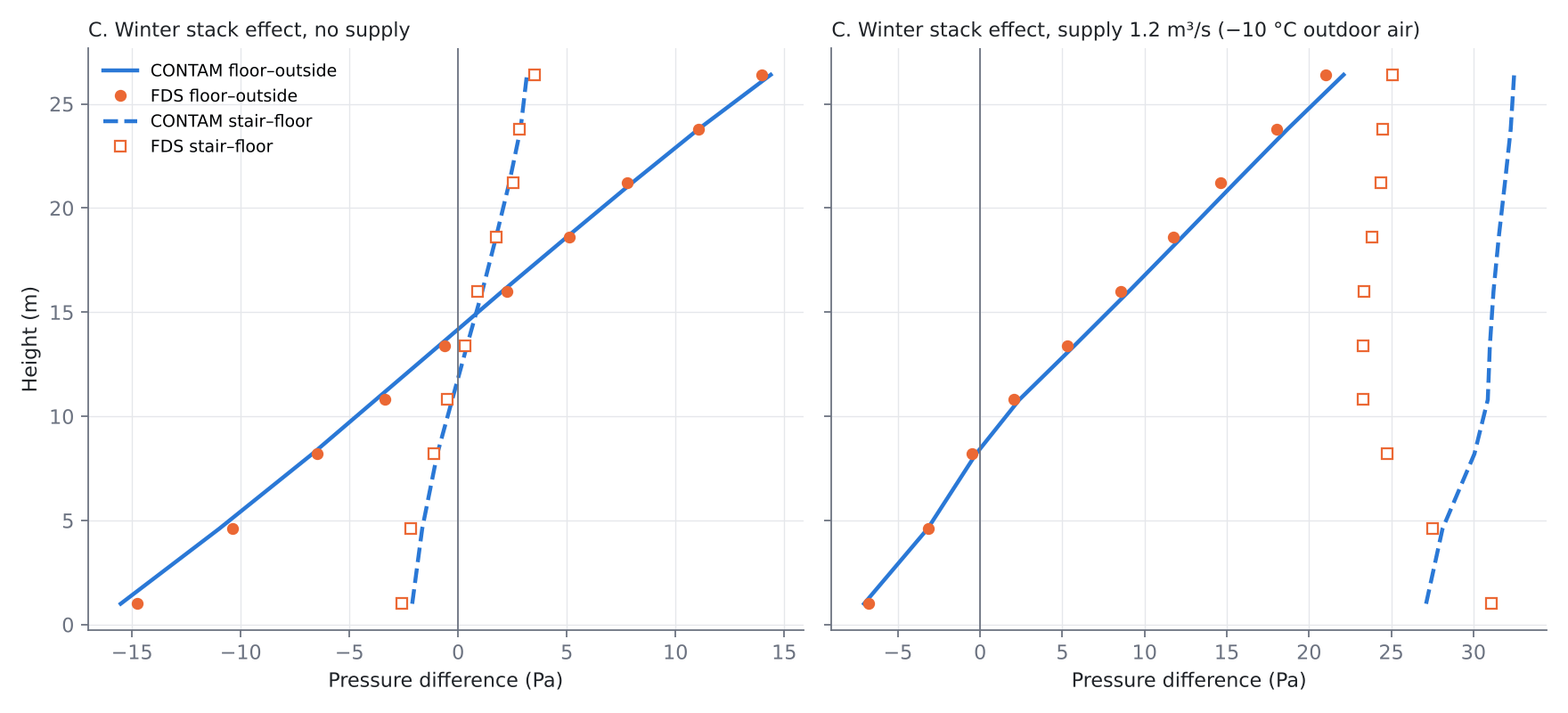
This scenario has no NRC measurement, so it is a code-to-code comparison: −10 °C outside, 21 °C inside.
- Without supply air, the two codes agree within 0.5 Pa on every floor. Pure stack effect with uniform temperatures is exactly what an airflow network is built for.
- With 1.2 m³/s of unheated outdoor air blown into the stair, the picture changes. In FDS the cold, dense air pools at the bottom of the shaft: the stair on the first three floors stays at about −10 / −8 °C, and there the stack effect reverses. CONTAM keeps the stair at the temperature you assign (21 °C), so it cannot see this, and its stair-to-floor pressure difference is off by 4–8 Pa, comparable to the design pressure difference itself.
Takeaway: unheated supply air in winter is not a detail. If the stair temperature is not uniform, a single-zone stair in CONTAM hides it.
D. Fire on floor 2 with the stair door open

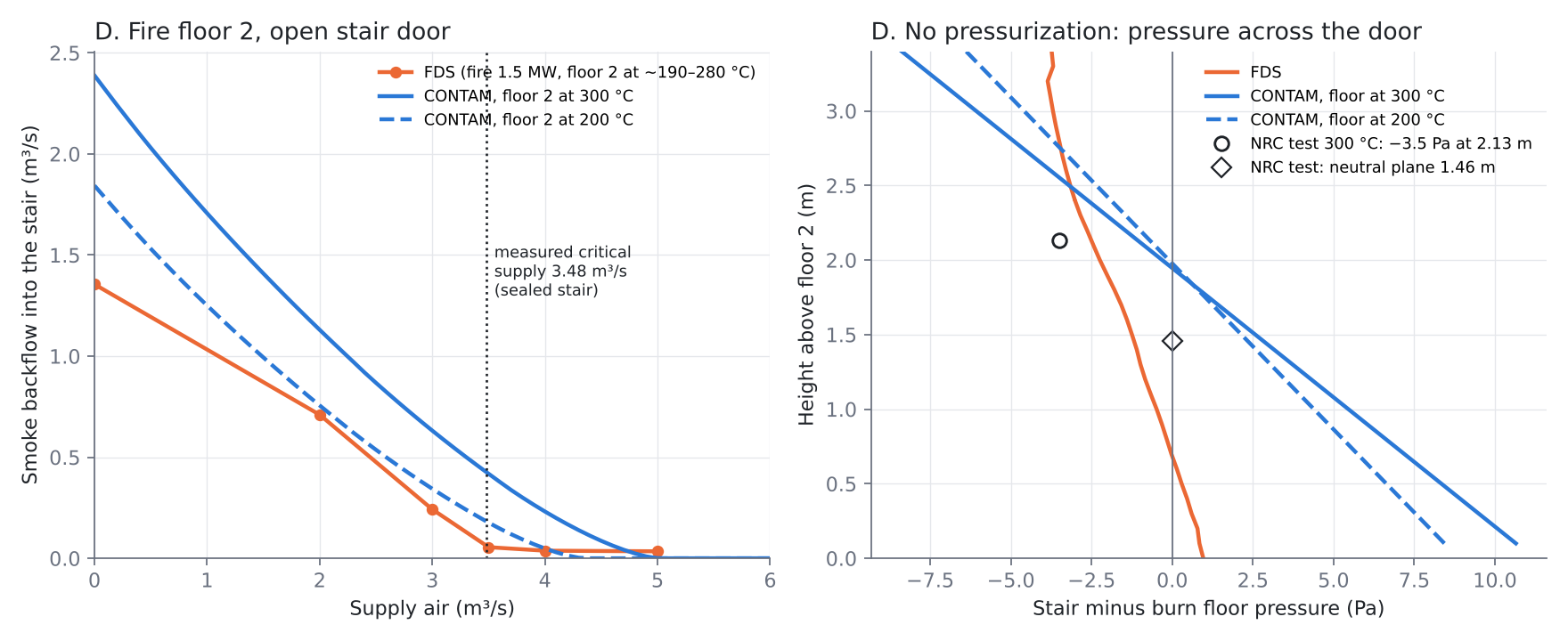
The last scenario is the one that matters for design: a propane fire on floor 2, the stair door open, and the supply air increased step by step until smoke stops entering the stair.
Minimum supply air to stop the smoke
- Measured: 3.48 m³/s.
- FDS: the smoke back-flow into the stair drops about 60 times between 3 and 3.5 m³/s and disappears at around 4 m³/s.
- CONTAM: 4.4 m³/s with the fire floor at 200 °C and 5.1 m³/s at 300 °C, so 25–45% conservative.
There is a catch in this comparison. In the NRC test the stair was sealed, while in our model it leaks about 0.6–0.8 m³/s to the other floors, so the supply air does not all reach the open door. The fairer comparison is the mean velocity through the door: FDS about 1.3–1.4 m/s, CONTAM about 1.75 m/s, measured 1.78 m/s at 300 °C. Considering that the fire floor in FDS is cooler (190–280 °C), both codes stay within about 20% of the measurement.
Without pressurization
| Measured | FDS | CONTAM | |
|---|---|---|---|
| Neutral plane height at the door | 1.46 m | 0.68 m | 1.95 m |
| Δp at 2.13 m | −3.5 Pa | −2.5 Pa | −1.0 Pa |
The reason is the stair temperature again. In FDS hot gas flows into the stair and the shaft starts working as a chimney, which pulls the neutral plane down. In CONTAM the stair stays at 20 °C, because zone temperatures are set by hand, and the pressure difference driving smoke into the stair is underestimated.
So, CONTAM or FDS?
The short answer from the NRC tower:
- CONTAM is the right tool for sizing pressurization with doors closed and for stack-effect checks with uniform temperatures. It runs in seconds on a single core, so you can sweep supply rates, door combinations and weather conditions in minutes.
- CONTAM is only as good as its inputs where the physics is not in the network: open-door discharge coefficients, stair friction, non-uniform temperatures. With typical default values it was 25–70% off in our cases.
- FDS computes those effects from geometry and boundary conditions, and in our runs stayed within about 10–35% of the measurements, with no tuned coefficients.
A practical workflow is to use both: CONTAM to explore the design space and size the fan, FDS to check the critical scenarios (open doors, cold supply air, fire) and, where needed, to calibrate the CONTAM coefficients for that building.
What it cost on cloudHPC
All FDS runs used FDS 6.10.1 on 32 vCPU highcpu spot instances on cloudHPC:
| Run | Cost |
|---|---|
| A. Sealed stair | €1.02 |
| B1. Floor 2 door open | €1.72 |
| B2. Floor 2 and exit doors open | €0.98 |
| C. Winter stack effect | €1.25 |
| D. Fire on floor 2 | €5.43 |
| Total | €10.40 |
The fire case was the longest, at about four hours. The four non-fire cases ran in about one hour each, side by side, so the whole study was done in an afternoon. Each CONTAM scenario ran in a few seconds on a single core.
With a full validation study costing about as much as a lunch, there is little reason not to back up an airflow-network design with a few CFD checks.
👉 Want to run your own FDS or pressurization study? Create a free cloudHPC account and launch your first simulation in minutes.
References
- Tamura, G.T. & Klote, J.H., Experimental fire tower studies of elevator pressurization systems for smoke control (AIVC).
- Tamura, G.T. & MacDonald, R.A., 1993, air leakage areas of the NRC fire tower (AIVC).
- Achakji, G.Y. & Tamura, G.T., pressure losses in stair shafts (AIVC).
- Tamura, G.T., 1989, ASHRAE RP-559, stair pressurization (AIVC).
- Tamura, G.T., 1991, ASHRAE Journal (NRC).
- Tamura, G.T., 1992, evaluation of stair pressurization systems (AIVC).
- NIST, CONTAM multizone airflow and contaminant transport.
- NIST, Fire Dynamics Simulator (FDS).
CloudHPC is a HPC provider to run engineering simulations on the cloud. CloudHPC provides from 1 to 224 vCPUs for each process in several configuration of HPC infrastructure - both multi-thread and multi-core. Current software ranges includes several CAE, CFD, FEA, FEM software among which OpenFOAM, FDS, Blender and several others.
New users benefit of a FREE trial of 300 vCPU/Hours to be used on the platform in order to test the platform, all each features and verify if it is suitable for their needs

