FDS version comparison: 6.9.1 vs 6.10.1 vs 6.11.1 on one input, checked against fire experiments
TL;DR. We ran the same seven FDS Validation Guide inputs with FDS 6.9.1, 6.10.1 and 6.11.1 on cloudHPC, on the same instance type, and compared every result with the experiment.
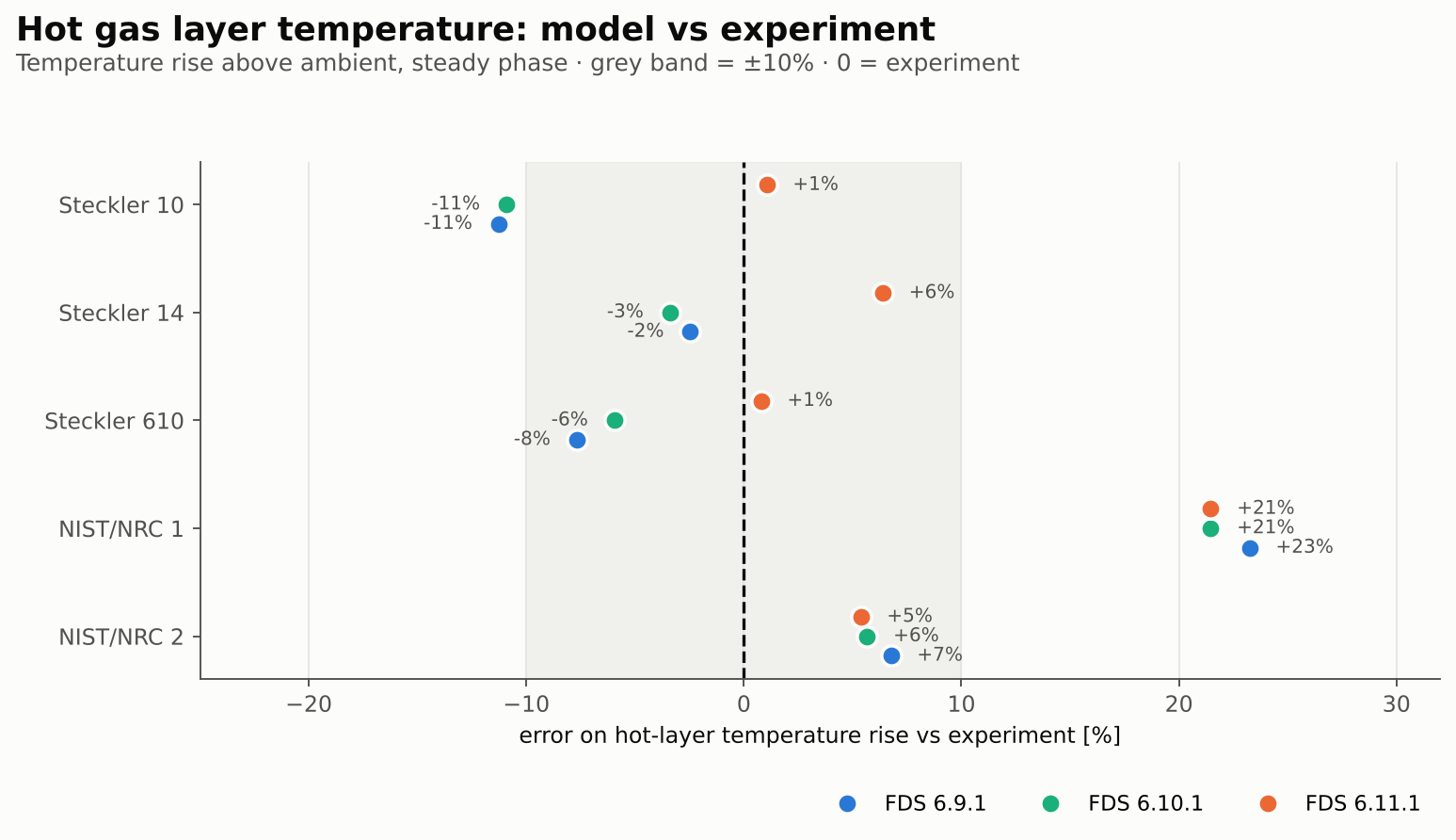
- Steckler compartment (3 tests): 6.11.1 predicts a hotter upper layer, by 8–20 °C. That brings the hot-layer temperature rise from −2 to −11% (6.9.1 and 6.10.1) to +1 to +6% of the measured value.
- McCaffrey plume (22 and 45 kW): 6.11.1 gives a cooler flame zone, with peak gas temperature about 100 °C lower, and a hotter plume above 1 m, closer to McCaffrey’s correlation at 2 m.
- NIST/NRC large compartment (tests 1 and 2): the three versions agree within 2 °C. All three over-predict the hot-layer temperature rise, by about 22% in test 1 and 5–7% in test 2.
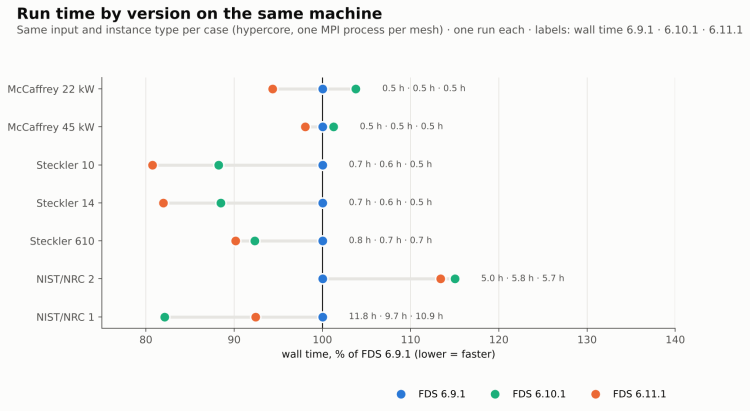
- Run time: 6.11.1 was 10–19% faster than 6.9.1 on the Steckler cases. On the long NIST cases there is no clear winner.
If you move a project from 6.9 or 6.10 to 6.11, expect small rooms to come out a few degrees hotter and flames a little cooler. Large-room hot-layer results stay the same. The 21 runs cost €63.50 in total.

Why an FDS version comparison
FDS, NIST’s Fire Dynamics Simulator, gets a new minor release about once a year. Fire engineers often keep a project on the version it started with, and then wonder whether a newer release would change the answer. The FDS team publishes a full Validation Guide with each release, but each guide shows only its own version.
6.10.0 (March 2025) added a new flux limiter correction for multi-component species transport, OpenMP acceleration of the boundary conditions and new pressure solvers. 6.11.0 (May 2026) lists a flux limiter overhaul, a new treatment of the corner boundary condition and a new default thermocouple material (Chromel/Alumel instead of pure nickel). 6.11.1 (July 2026) is a bug-fix release [1, 2]. Some of these changes can affect temperatures directly.
So we took three classic validation experiments, used one input file per case for all three versions, and ran them on cloudHPC.
Results at a glance
| Case | Quantity | Experiment | FDS 6.9.1 | FDS 6.10.1 | FDS 6.11.1 |
|---|---|---|---|---|---|
| Steckler 10 (narrow door) | upper layer temperature | 180.1 °C | 162.3 °C (−11%) | 162.8 °C (−11%) | 181.8 °C (+1%) |
| Steckler 14 (wide door) | upper layer temperature | 115.3 °C | 113.1 °C (−2%) | 112.3 °C (−3%) | 120.9 °C (+6%) |
| Steckler 610 (burner at wall) | upper layer temperature | 131.9 °C | 123.1 °C (−8%) | 125.1 °C (−6%) | 132.8 °C (+1%) |
| McCaffrey 22 kW | peak gas temperature on axis | – | 1,165 °C | 1,169 °C | 1,057 °C |
| McCaffrey 22 kW | temperature rise at 2 m | 76 °C | 57 °C | 58 °C | 68 °C |
| McCaffrey 45 kW | temperature rise at 2 m | 111 °C | 90 °C | 89 °C | 101 °C |
| NIST/NRC 1 (≈ 420 kW) | hot layer, 300–1350 s | 119.9 °C | 142.9 °C (+23%) | 141.1 °C (+21%) | 141.1 °C (+21%) |
| NIST/NRC 2 (≈ 1.2 MW) | hot layer, 300–625 s | 220.7 °C | 234.0 °C (+7%) | 231.9 °C (+6%) | 231.3 °C (+5%) |
Percentages are errors on the temperature rise above ambient, which is how the FDS Validation Guide reports them. Steckler values are averaged over the last 30 s of the steady state. For the McCaffrey “experiment” column we use McCaffrey’s correlation of his measurements (see below).
How the runs were set up
- Inputs: taken from the FDS repository at tag
FDS-6.9.1(Validation/McCaffrey_Plume,Steckler_Compartment,NIST_NRC) [3]. The same file went to all three versions. These are cases from the FDS Validation Guide [9]. Experimental data come from thefiremodels/exprepository [4]. - Our changes, identical for all versions:
MULTmesh blocks written out as explicit&MESHlines. cloudHPC starts one MPI process per&MESHline and does not countMULT_IDcopies.- The single Steckler mesh split into 8 meshes (4 × 1 × 2) away from the door and the burner.
DT_RESTARTadded, so the runs could use cheaper spot instances.- Machines:
- hypercore instances, one MPI process per mesh;
- Steckler and NIST/NRC: 8 vCPU;
- McCaffrey: 32 vCPU for 27 meshes.
- All 21 runs used spot instances; none was interrupted.
- Comparisons: time-averaged device and line outputs, never single snapshots, because LES results fluctuate.
Case 1 · Steckler compartment (NBS, 1982)

Steckler, Quintiere and Rinkinen measured the flow induced by a steady 62.9 kW methane fire in a 2.8 × 2.8 × 2.13 m room, varying the door width and the burner position [5]. We used three of their tests:
- test 10: narrow 0.24 m door, burner in the centre;
- test 14: wide 0.74 m door, burner in the centre;
- test 610: wide door, burner against the back wall.
The rakes measure the temperature profile in the room and the temperature and velocity profiles in the doorway.


| Test | Quantity | Experiment | 6.9.1 | 6.10.1 | 6.11.1 |
|---|---|---|---|---|---|
| 10 | upper layer temperature | 180.1 °C | 162.3 °C | 162.8 °C | 181.8 °C |
| 10 | peak outflow velocity in door | 3.20 m/s | 2.77 m/s | 2.73 m/s | 2.74 m/s |
| 14 | upper layer temperature | 115.3 °C | 113.1 °C | 112.3 °C | 120.9 °C |
| 14 | peak outflow velocity in door | 2.18 m/s | 1.93 m/s | 1.92 m/s | 1.93 m/s |
| 610 | upper layer temperature | 131.9 °C | 123.1 °C | 125.1 °C | 132.8 °C |
| 610 | peak outflow velocity in door | 2.19 m/s | 1.84 m/s | 1.80 m/s | 1.91 m/s |
What we learned. 6.9.1 and 6.10.1 give practically the same answer. 6.11.1 shifts the upper layer up by 8–20 °C, which in these three tests takes it from slightly cold to on target.
The doorway flow does not change between versions. All three under-predict the peak outflow velocity by 12–18%. That comparison has a caveat: our input samples the point gas velocity, while the experiment used bi-directional probes. 6.11 adds an output that models such a probe [6]; we did not use it, so the inputs stay identical.
The layer interface comes out 0.13–0.2 m lower than in the experiment for all versions.
The room temperatures use gas temperature, not the thermocouple model. So the 6.11.1 shift does not come from the new thermocouple default. It comes from the solver changes: flux limiter, corner boundary condition or both. Our runs cannot separate the two.
Case 2 · McCaffrey plume (NBS, 1979)

McCaffrey measured temperature and velocity on the axis of buoyant diffusion flames from a 0.3 m square porous burner, and condensed them into a correlation with three regions: continuous flame, intermittent flame and plume [7]. We ran the 21.7 kW and 44.9 kW cases. Each run simulates 30 s, averaged from 10 to 30 s, on 27 meshes with 2.7 cm cells (1.48 million cells).

| Burner | Quantity | McCaffrey | 6.9.1 | 6.10.1 | 6.11.1 |
|---|---|---|---|---|---|
| 22 kW | peak thermocouple temperature | – | 949 °C | 951 °C | 881 °C |
| 22 kW | peak gas temperature | – | 1,165 °C | 1,169 °C | 1,057 °C |
| 22 kW | rise at 0.6 m (intermittent) | 405 °C | 415 °C | 436 °C | 532 °C |
| 22 kW | rise at 2.0 m (plume) | 76 °C | 57 °C | 58 °C | 68 °C |
| 45 kW | peak thermocouple temperature | – | 863 °C | 866 °C | 795 °C |
| 45 kW | peak gas temperature | – | 1,002 °C | 1,007 °C | 905 °C |
| 45 kW | rise at 0.6 m (intermittent) | 535 °C | 709 °C | 693 °C | 669 °C |
| 45 kW | rise at 2.0 m (plume) | 111 °C | 90 °C | 89 °C | 101 °C |
What we learned. Again, 6.9.1 and 6.10.1 are almost identical, and 6.11.1 is the one that moves:
- Flame zone: both the peak gas temperature and the thermocouple reading drop by about 70–110 °C. Because the gas temperature drops too, the new thermocouple default is not the only cause.
- Plume: higher up, 6.11.1 is hotter and closer to McCaffrey’s correlation (−10% at 2 m instead of −20 to −25%).
- Intermittent region (around 0.6 m): the picture is mixed. At 22 kW, 6.11.1 over-predicts by 31%, against 2–8% for the older versions; at 45 kW, all versions over-predict, by 25–32%.
The correlation is a fit, not raw data. These are 30 s LES runs, so differences of a few percent are within the noise.
Case 3 · NIST/NRC compartment fires (NIST, 2003)

The NIST/NRC series (International Fire Model Benchmarking and Validation Exercise #3) burned heptane spray fires in a 21.7 × 7.04 × 3.82 m compartment [8]. As modelled in the Validation Guide input, tests 1 and 2 have no open vents, only leakage:
- Test 1: about 420 kW for 20 min.
- Test 2: about 1.2 MW for 7 min, then the fire is switched off.
These are the expensive runs: 1,800 s of physical time on 8 meshes with 10 cm cells, plus Lagrangian droplets for the spray.

| Test | Quantity | Experiment | 6.9.1 | 6.10.1 | 6.11.1 |
|---|---|---|---|---|---|
| 1 | hot layer, steady phase | 119.9 °C | 142.9 °C | 141.1 °C | 141.1 °C |
| 1 | peak hot layer | 143.8 °C | 178.2 °C | 167.1 °C | 170.5 °C |
| 1 | layer height | 1.18 m | 1.08 m | 0.93 m | 0.94 m |
| 2 | hot layer, steady phase | 220.7 °C | 234.0 °C | 231.9 °C | 231.3 °C |
| 2 | peak hot layer | 253.2 °C | 261.7 °C | 261.6 °C | 256.3 °C |
| 2 | layer height | 1.09 m | 0.81 m | 0.76 m | 0.76 m |
What we learned. In a large compartment the version does not matter: the three hot-layer curves overlap within 2 °C for the whole test. Test 2 is predicted within 5–7% of the measured temperature rise.
Test 1 is over-predicted by about 22% in every version, and the gap opens after 5 minutes. So it is a property of this model set-up, not of a release. The likely causes are heat losses to the walls and the leakage through the enclosure, and both are the same in all three versions.
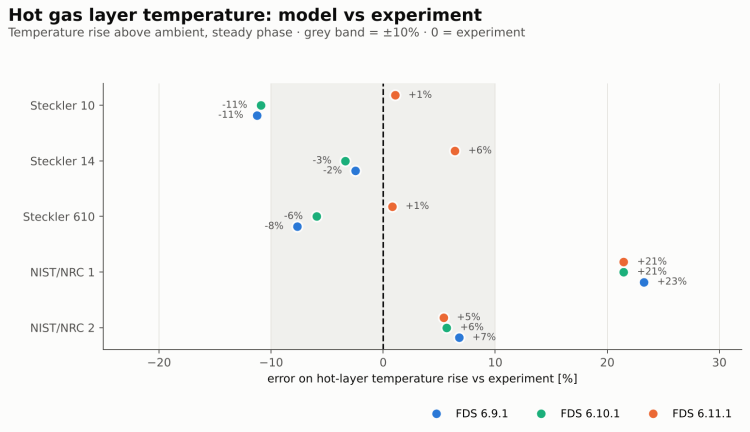
Hot-layer error: all five compartment tests
Run times and costs on cloudHPC
| Case | vCPU (hypercore) | 6.9.1 | 6.10.1 | 6.11.1 |
|---|---|---|---|---|
| McCaffrey 22 kW (30 s) | 32 | 29 min · €2.17 | 30 min · €2.16 | 27 min · €2.03 |
| McCaffrey 45 kW (30 s) | 32 | 32 min · €2.39 | 33 min · €2.36 | 32 min · €2.30 |
| Steckler 10 | 8 | 40 min · €0.81 | 35 min · €0.62 | 32 min · €0.61 |
| Steckler 14 | 8 | 39 min · €0.80 | 35 min · €0.61 | 32 min · €0.60 |
| Steckler 610 | 8 | 46 min · €0.84 | 43 min · €0.79 | 42 min · €0.77 |
| NIST/NRC 2 (1,800 s) | 8 | 5.0 h · €4.53 | 5.8 h · €5.17 | 5.7 h · €5.10 |
| NIST/NRC 1 (1,800 s) | 8 | 11.8 h · €10.51 | 9.7 h · €8.63 | 10.9 h · €9.70 |
| Total | €22.05 | €20.34 | €21.11 |
Times are FDS wall-clock times from the .out files. Costs are the full cloudHPC job charges on spot instances, including start-up and result upload.
What we learned:
- On the Steckler rooms, 6.11.1 is the fastest version, 10–19% faster than 6.9.1, with 6.10.1 in between.
- On McCaffrey the differences are within ±6%.
- The two NIST runs disagree with each other: 6.10.1 is the fastest on test 1 and the slowest on test 2. With one run each, on shared cloud hardware, a ±15% difference on a 5–12 h run is not a reliable version effect.
The number of time steps is practically the same for all versions (within 4%), so any speed difference comes from the cost per step, not from a smaller time step.
Should you upgrade?
- Small and medium rooms: expect a hotter upper layer with 6.11.1 (up to about 20 °C in these tests). Against Steckler’s data the change is an improvement. If you compare a new run with an old one, rerun the old one in the new version rather than mixing results.
- Flames and plumes near the fire: 6.11.1 predicts lower peak flame temperatures. That matters for the incident heat flux to nearby targets, so check targets close to the fire again.
- Large-volume hot-layer results (warehouses, halls, car parks, as in the NIST/NRC tests): no meaningful change between versions.
- Speed: equal or better with 6.11.1 on the short cases; not conclusive on the long ones.
On cloudHPC every FDS version from 6.7.0 to the latest is installed. You can run the same input with two versions at the same time and compare them yourself.
How to run a version comparison on cloudHPC
- Write out
MULTmeshes as explicit&MESHlines. cloudHPC starts one MPI process per&MESHline;MULT_IDcopies are not counted. - Split single-mesh inputs into several meshes, with boundaries away from burners and doors.
- Add
DT_RESTARTto&DUMP. FDS can then run on spot instances, and cloudHPC restarts it automatically if the instance is reclaimed. - Choose hypercore or highcore with as many vCPU as meshes, rounded up to an available size.
- Launch the same folder once per version (select the FDS version in the solver list), then compare the
_devc.csvand_line.csvfiles.
FAQ
Does FDS 6.11 give different results from FDS 6.9 or 6.10?
Yes, in some cases. In our runs, 6.11.1 predicted an 8–20 °C hotter upper layer in the Steckler compartment and 70–110 °C lower peak flame temperatures in the McCaffrey plume. In the large NIST/NRC compartment, all three versions agreed within 2 °C.
Is FDS 6.11 more accurate than 6.10?
For the Steckler hot-layer temperature, yes: the error on the temperature rise went from −2 to −11% to +1 to +6%. For the McCaffrey plume it is better above 1 m and mixed in the intermittent flame region. For the NIST/NRC tests the accuracy is unchanged.
Why did the FDS 6.11 thermocouple readings change?
6.11.0 changed the default thermocouple properties from pure nickel to a 50/50 Chromel/Alumel mix. In our McCaffrey runs the gas temperature changed as much as the thermocouple reading, so solver changes (flux limiter, corner boundary condition) are also involved.
Is FDS 6.11 faster?
On the Steckler cases it was 10–19% faster than 6.9.1 with the same input and machine. On the McCaffrey and NIST/NRC cases the differences were mixed and within run-to-run variability.
How much does it cost to run the FDS validation cases on the cloud?
On cloudHPC, the Steckler cases cost €0.60–0.85 each and the McCaffrey cases about €2. The 1,800 s NIST/NRC cases cost €4.50–10.50 each on spot instances. Our full set of 21 runs cost €63.50.
References
- FDS Release Notes, firemodels/fds wiki (6.10.0, 6.10.1, 6.11.0, 6.11.1). github.com/firemodels/fds/wiki/FDS-Release-Notes
- FSRI, “Fire Dynamics Simulator Releases Version 6.11”, 30 July 2026. fsri.org
- Fire Dynamics Simulator source and validation inputs, tag FDS-6.9.1. github.com/firemodels/fds
- Experimental data repository for FDS validation. github.com/firemodels/exp
- K.D. Steckler, J.G. Quintiere, W.J. Rinkinen, “Flow Induced by Fire in a Compartment”, NBSIR 82-2520, National Bureau of Standards, 1982.
- FSRI, FDS 6.11 summary: new bi-directional probe output. fsri.org
- B.J. McCaffrey, “Purely Buoyant Diffusion Flames: Some Experimental Results”, NBSIR 79-1910, National Bureau of Standards, 1979.
- A. Hamins et al., “Report of Experimental Results for the International Fire Model Benchmarking and Validation Exercise #3”, NIST SP 1013-1 / NUREG/CR-6905, 2005.
- K. McGrattan et al., “Fire Dynamics Simulator Technical Reference Guide, Volume 3: Validation”, NIST SP 1018-3. pages.nist.gov/fds-smv
CloudHPC is a HPC provider to run engineering simulations on the cloud. CloudHPC provides from 1 to 224 vCPUs for each process in several configuration of HPC infrastructure - both multi-thread and multi-core. Current software ranges includes several CAE, CFD, FEA, FEM software among which OpenFOAM, FDS, Blender and several others.
New users benefit of a FREE trial of 300 vCPU/Hours to be used on the platform in order to test the platform, all each features and verify if it is suitable for their needs

