XBeach: Modeling the Coast Where It Changes Fastest
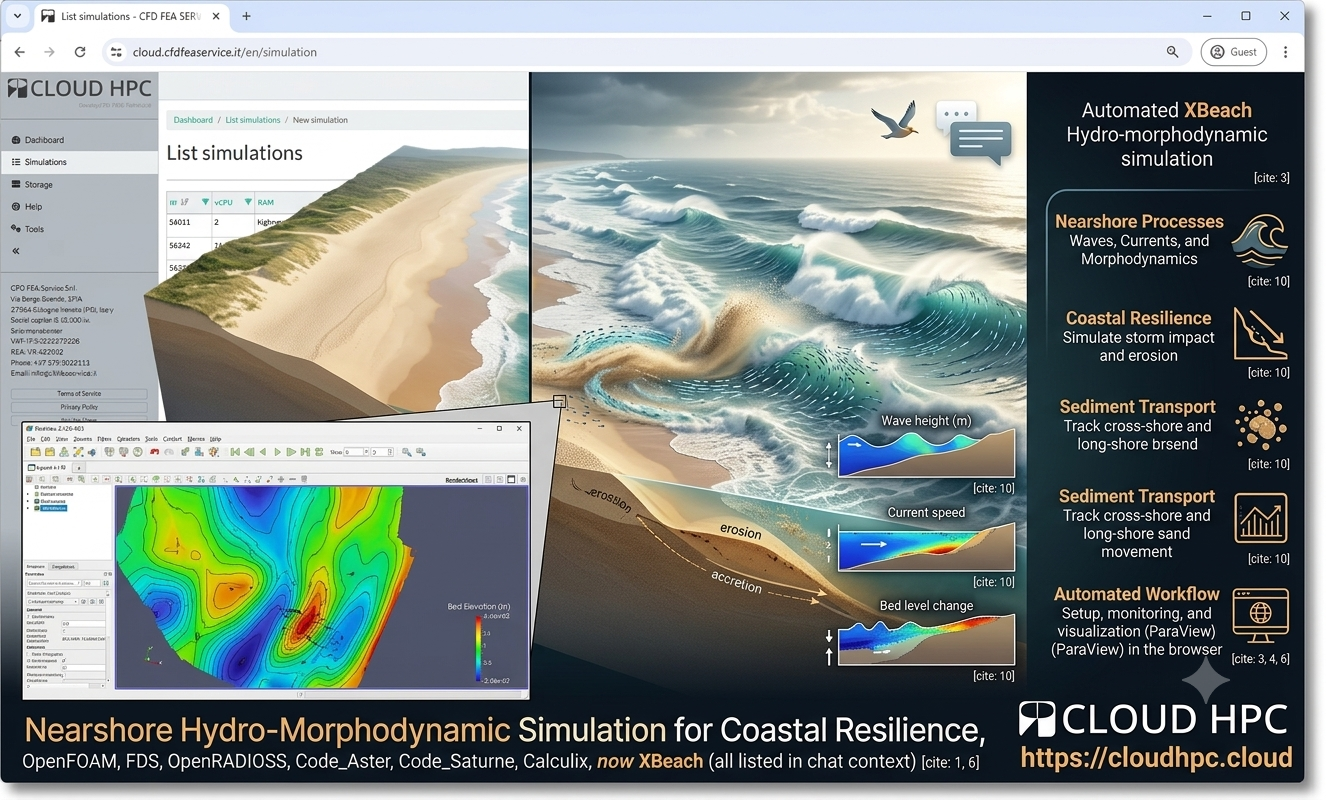
Coastlines are where the most damaging events in coastal engineering happen in hours, not years: a single storm can carve meters of dune out of a beach, breach a barrier island, or push a surge far enough inland to flood a community that hasn’t seen water in a generation. Predicting that kind of rapid, nonlinear change is a genuinely hard modeling problem — and it’s the problem XBeach was built to solve.
What XBeach is
XBeach is an open-source (GPL) numerical model for simulating nearshore hydrodynamics, sediment transport, and morphological change during storms and extreme events. It was originally developed with support from the US Army Corps of Engineers and a consortium including Deltares, Delft University of Technology, UNESCO-IHE, and the University of Miami, and it has since become one of the most widely used and peer-validated coastal models in the world — with several hundred published journal applications, from Pacific atolls to Dutch dune coasts to hurricane-exposed barrier islands.
What sets it apart from a generic wave or flow solver is that it’s purpose-built for the storm problem: short-timescale, high-energy events where waves, currents, sediment transport, and morphology are all changing together and feeding back into each other. You don’t run XBeach to understand average conditions — you run it to understand what happens to a coastline in the worst 48 hours of the year.
Core capabilities
Coupled wave-flow-sediment-morphology solving. XBeach solves short-wave energy propagation (via a wave-action balance), infragravity (long) waves, depth-averaged flow, sediment transport, and bed-level change in a single time-stepping loop, so morphological change actively feeds back into the hydrodynamics as the simulation progresses — a dune doesn’t just erode at the end of the calculation, it erodes while the waves that are eroding it keep responding to the new shape.
Storm impact regimes. The model explicitly resolves the four recognized storm-impact regimes on sandy coasts — swash, collision, overwash, and inundation — making it the standard tool for questions like “will this dune hold, or will the barrier island breach?”
Two solving modes. A computationally efficient surfbeat mode resolves wave groups and infragravity motion without resolving every individual wave crest (fast enough for long storm durations and large domains), and a non-hydrostatic mode resolves individual short waves directly for problems where wave-by-wave detail — overtopping, wave asymmetry, reef hydrodynamics — actually matters.
Sediment and morphology variants. Beyond the standard sand-transport formulation, the XBeach-G variant handles gravel and mixed sediment beaches (relevant for shingle coasts and post-storm berm recovery studies), and the model supports avalanching, breaching, and dune-face collapse mechanics.
2D domains with real bathymetry/topography. XBeach runs on structured curvilinear grids that can follow an arbitrary coastline, ingest LiDAR-derived topography and survey bathymetry, and represent hard structures (seawalls, revetments) alongside the natural profile.
Ensemble-friendly by design. Because coastal risk is inherently probabilistic — you rarely care about one storm, you care about the distribution of outcomes across plausible storm tracks, water levels, and wave conditions — XBeach is very commonly run as dozens or hundreds of parallel scenario variants rather than a single deterministic case.
Why that makes it a cloud HPC problem
Each of the capabilities above has a computational cost attached, and together they push XBeach studies past what a single workstation comfortably handles:
- Storm-duration timescales at fine spatial resolution. A realistic dune-erosion study needs a grid fine enough to resolve the swash zone and dune face, run continuously across an entire storm surge event — often tens of thousands of time steps.
- Non-hydrostatic mode is expensive. Resolving individual short waves instead of wave groups multiplies the number of time steps needed by an order of magnitude or more for the same simulated duration.
- Real studies are ensembles, not single runs. A coastal risk assessment isn’t one storm — it’s a matrix of storm tracks, return periods, sea-level-rise scenarios, and structural design alternatives, each requiring its own full run. That’s an embarrassingly parallel workload that scales almost linearly with the number of cores you can throw at it.
- MPI parallelization is built in, so XBeach scales across nodes for large domains — but only if you have the nodes to scale across, and provisioning and correctly configuring a multi-node MPI cluster for something you’ll run intermittently is exactly the kind of infrastructure overhead most coastal engineering teams don’t want to own.
This is precisely the gap cloudHPC is built to close. Instead of maintaining dedicated cluster hardware for workloads that spike around storm seasons, permit deadlines, and design reviews, a team can spin up a properly configured, MPI-ready XBeach environment on demand, size it to the study — more cores for a large ensemble, more memory for a fine-resolution non-hydrostatic domain — and shut it down the moment the results are in. Large ensembles that would take days sequentially on a workstation compress down to however long your longest single scenario takes, run in parallel.
If your work involves storm-impact assessment, dune and barrier-island stability, coastal flood risk, or nature-based defense design, that’s the difference between running the three or four scenarios you have time for and running the full probabilistic study the problem actually deserves.
Need to run XBeach storm-impact ensembles without building out your own cluster? cloudhpc.cloud provides on-demand, pre-configured HPC environments for XBeach alongside CFD and FEA simulation workloads.
CloudHPC is a HPC provider to run engineering simulations on the cloud. CloudHPC provides from 1 to 224 vCPUs for each process in several configuration of HPC infrastructure - both multi-thread and multi-core. Current software ranges includes several CAE, CFD, FEA, FEM software among which OpenFOAM, FDS, Blender and several others.
New users benefit of a FREE trial of 300 vCPU/Hours to be used on the platform in order to test the platform, all each features and verify if it is suitable for their needs