SU2 vs OpenFOAM: RANS verification on NASA TMR cases and cloud scalability up to 69 million cells
TL;DR
- Same grids, same Spalart–Allmaras model, two codes: SU2 8.3 (density-based, vertex-centred) and OpenFOAM.org 13 (pressure-based, cell-centred) on three NASA Turbulence Modeling Resource cases, 3.5 thousand to 69.2 million cells.
- Subsonic it is a tie: on the 3D bump the finest-grid drag of the two codes differs by 0.2 %, both within 1.5 % of CFL3D and FUN3D; on the NACA 0012 at 10° both give CD = 0.01236 on the 1793×513 grid, with lift 0.6 % apart.
- Transonic, SU2 is sharper: on the ONERA M6 SU2 places the shock within 0.011 chord of the experiment on 8.65 M cells; OpenFOAM is 0.045–0.074 chord aft on the same grid and needs the 69 M-cell grid to get within 0.023 chord.
- Speed per iteration is close (1–8 % at 48–112 cores); memory is not: SU2 needs 3–4× the RAM (9–11 GB per million cells vs about 2–3.6 GB). On 192 AMD Turin cores OpenFOAM needed 24 % less time per iteration (0.715 vs 0.94 s).
- The processor matters more than the code: 96 Turin cores run the 8.65 M-cell wing about 2× faster than 112 Milan cores, for about the same solver cost per 1000 iterations (€4–6).

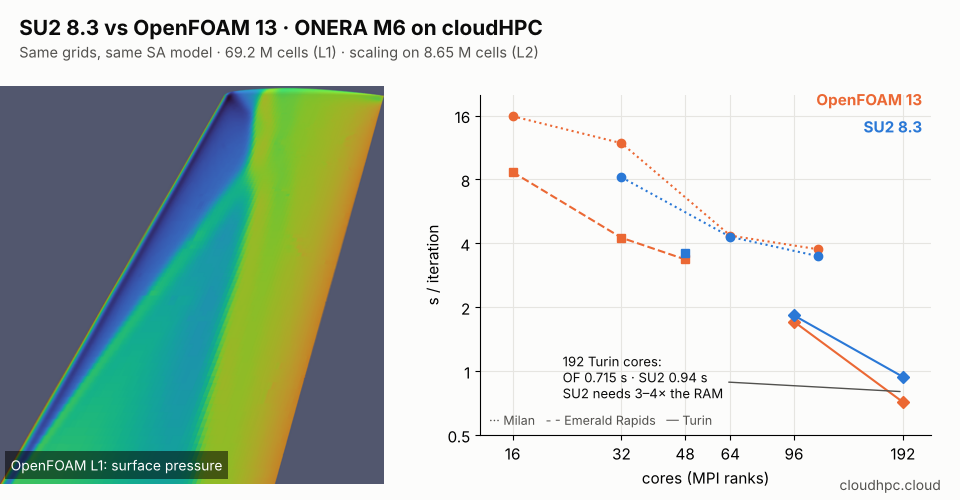
OpenFOAM 13 on the ONERA M6 L1 grid (surface pressure ↔︎ wall shear stress) and time per iteration of both codes on the 8.65 M-cell L2 grid, three processor families, cloudHPC.
Why compare SU2 and OpenFOAM now
Many engineering teams run OpenFOAM for compressible external aerodynamics simply because they already use it for everything else. Few know how far a pressure-based, cell-centred code is from an aerospace density-based code on the same mesh with the same turbulence model. SU2 and OpenFOAM are both open source, both finite volume, and both run on cloudHPC, so we could remove every difference except the numerics.
We presented this work at the 7th SU2 Conference at Politecnico di Milano (9–11 November 2026). This post gives the results, the settings that worked, the ones that did not, and the cost of running it on the cloud.
The study had four goals:
- Verification: forces, Cp and Cf against the NASA Turbulence Modeling Resource (TMR) references and experiments.
- Grid convergence: four nested grids per case, up to 69.2 million cells on the ONERA M6.
- Practical settings: every configuration tried, failures included, so others can reproduce it.
- Parallel performance: strong scaling and memory on identical cloud hardware.
Results at a glance
| Case (finest grid) | Quantity | SU2 8.3 | OpenFOAM 13 | Reference |
|---|---|---|---|---|
| 3D bump-in-channel (33×353×161) | CD | 0.003643 | 0.003635 | CFL3D 0.003629 · FUN3D 0.003601 |
| 3D bump-in-channel | CL (extrapolated) | 0.02504 | 0.02509 | NASA 0.02501 |
| NACA 0012, α = 10° (1793×513) | CL / CD | 1.0972 / 0.01236 | 1.0903 / 0.01236 | FUN3D–CFL3D offset of the same size |
| NACA 0012, 897×257 | Suction peak Cp at 10° / 15° | −5.70 / −11.20 | −5.67 / −11.17 | Gregory & O’Reilly data |
| ONERA M6, L1 (69.2 M) | CL / CD | 0.2709 / 0.01720 | 0.2763 / 0.01764 | NASA 0.2692–0.2706 / 0.01691–0.01705 |
| ONERA M6, L2 (8.65 M) | Max shock offset vs experiment | 0.011 c | 0.074 c (0.023 c on L1) | ONERA test 2308 |
| ONERA M6, L2, 192 Turin cores | Time per iteration | 0.94 s | 0.715 s | – |
| ONERA M6, L2 | Peak memory (all ranks) | 76–95 GB | 17–31 GB | – |
How the runs were set up

Set-up of the three cases. Both codes read exactly the same grids: we converted the NASA grids to SU2 and OpenFOAM formats and checked cell count, wall area and volume.
Three NASA TMR cases, in rising difficulty:
- 3D bump-in-channel: M = 0.2, Re = 3×10⁶ per unit length, grids from 5×45×21 to 33×353×161 (3.5 thousand to 1.8 million cells). Pure verification: no experiment, references from CFL3D and FUN3D.
- NACA 0012: M = 0.15, Re = 6×10⁶, α = 0°, 10°, 15°, grids from 225×65 to 1793×513. References CFL3D and FUN3D, experiments by Gregory & O’Reilly and Ladson.
- ONERA M6 wing: M = 0.84, α = 3.06°, Re = 14.6×10⁶ based on the root chord, hexahedral grids L4 to L1 (135 thousand to 69.2 million cells, y+ ≈ 0.5) from the NASA
hcf_wingfamily. References: NASA SA results and the ONERA experiment (test 2308, which ran at slightly different Mach and Reynolds numbers, so the shock comparison is qualitative).
| Item | SU2 8.3.0 | OpenFOAM.org 13 |
|---|---|---|
| Turbulence model | SA without ft2, ν̃∞ = 3ν∞ | SpalartAllmaras (no ft2), ν̃∞ = 3ν∞ |
| Formulation | Density-based, coupled, vertex-centred | Pressure-based, segregated, cell-centred |
| Convection | Roe, 2nd-order MUSCL | linearUpwind (U, e), limitedLinear 1 (p) |
| Limiter (M6) | Venkatakrishnan–Wang, K = 0.05 | Barth–Jespersen, cellLimited 0.5 |
| Iteration | Implicit Euler, FGMRES + ILU(0) | M6: PIMPLE with local Δt; bump and NACA: SIMPLEC |
| Stopping | Cauchy on CL and CD (10⁻⁵ M6, 10⁻⁸ NACA) | Fixed iterations, forces averaged over the last 500 |
| Walls / far field | Adiabatic, no wall functions; characteristic far field | Adiabatic, no wall functions; freestream (M6, NACA), total-pressure inlet and static outlet (bump) |
We checked the OpenFOAM 13 SA source line by line: apart from clipping the modified vorticity at 0.3 Ω it is standard SA without ft2. The laminar Prandtl number differs slightly (0.72 against about 0.74 from the modified Eucken model in SU2), with no visible effect.
All runs used one MPI rank per physical core on cloudHPC highcore (AMD EPYC Milan) and hypercore (Intel Xeon Emerald Rapids, AMD EPYC Turin) machines, on spot instances.
What it took to run robustly (and what didn’t work)
The failures are as useful as the final recipe. Only the final configurations appear in the results.
OpenFOAM 13
- ONERA M6 with a global time step diverged; local time stepping with smoothing 0.2 works.
- Capping the pressure GAMG solver at 20 iterations gave the same forces and was 40 % faster per iteration.
cellMDLimitedwas unstable; TVD schemes were too dissipative.cellLimited 1(full Barth–Jespersen) gave a chequerboard skin friction in the supersonic region: the limiter switched on and off between neighbouring cells.cellLimited 0.5is smooth and moves the forces slightly towards NASA.- NACA 0012 at M = 0.15: transient PIMPLE was unstable, steady SIMPLEC converges.
SU2 8.3
- M6 L3: CFL up to 100 diverged; a CFL ramp from 5 to 20 works.
- M6 L1: freezing the limiter made the run diverge. Never freeze the limiter.
- NACA 0012: a Cauchy criterion of 10⁻⁶ stopped too early, with lift 1 % high; residual-only stopping was too loose and left a limit cycle on the coarse grids. Cauchy 10⁻⁸ over 1000 iterations converged.
- One M6 L2 run went unstable after about 5200 iterations and diverged at about 7400. Add a hard iteration cap and don’t overwrite restart files.
Case 1: 3D bump-in-channel

3D bump: total, pressure and viscous drag and lift against grid spacing h = N^(−1/3). Hollow symbols: lift extrapolated to full iterative convergence.
| Finest grid 33×353×161 | SU2 8.3 | OpenFOAM 13 | CFL3D | FUN3D |
|---|---|---|---|---|
| CD | 0.003643 | 0.003635 | 0.003629 | 0.003601 |
| CL (extrapolated) | 0.02504 | 0.02509 | NASA 0.02501 | |
The two codes converge from opposite sides. On the 9×89×41 grid SU2’s drag is 21 % above the NASA average and OpenFOAM’s 15 % below; on the finest grid both are within 1.5 % of CFL3D and FUN3D and 0.2 % from each other. In their grid-convergence trend SU2 follows CFL3D and OpenFOAM follows FUN3D (on the NACA 0012 the pairing is reversed). OpenFOAM predicts more viscous drag and SU2 more pressure drag, and the two partly cancel in the total.

Centreline Cp and Cf on the two finest grids, 0.03 < x < 1.47.
On the centreline the Cp and Cf curves are on top of each other. SU2 shows small Cf steps on the 17×177×81 grid where the Venkatakrishnan limiter is active (x ≈ 0.58 and 0.9); they disappear on the next grid. The spikes at x = 0 and 1.5 (cut from the plot) are the flat-plate leading-edge singularity where the no-slip wall starts and ends, in both codes.
What we learned: for a smooth subsonic flow the two codes are interchangeable, but a coarse-grid answer in either one can be off by 15–21 % in drag.
Case 2: NACA 0012 near maximum lift

NACA 0012, α = 10°: lift and drag against grid spacing. The grey bar marks the spread between CFL3D and FUN3D on the 897×257 grid.
On the 1793×513 grid both codes give CD = 0.01236. Lift is 1.0972 (SU2) against 1.0903 (OpenFOAM), 0.6 % apart: the same offset separates FUN3D (vertex-centred, like SU2) from CFL3D (cell-centred, like OpenFOAM), and on the 897×257 reference grid SU2 matches FUN3D and OpenFOAM matches CFL3D at 0°, 10° and 15°.
SU2’s drag converges monotonically, from 0.0177 on the coarsest grid to 0.0124. OpenFOAM is already close to 0.012 on the coarsest grid, then moves by ±3 % without a trend. That is not better accuracy: pressure and friction errors that partly cancel. Trust trends over three grids, not one coarse value.

NACA 0012 on the 897×257 grid: Cp with the upper-surface data of Gregory & O’Reilly, and streamwise Cf, at 0°, 10° and 15°.
The Cp and Cf curves of the two codes are indistinguishable and both follow the experiment. The suction peak is −5.70 (SU2) and −5.67 (OpenFOAM) at 10°, −11.20 and −11.17 at 15°. OpenFOAM’s wall pressure was taken from the wall cells, because the patch value is zero-gradient.
What we learned: iterative convergence matters as much as the grid. Tightening SU2’s Cauchy criterion from 10⁻⁶ to 10⁻⁸ moved lift by 1 % and drag by 4 %, more than the change between the two finest grids.
Case 3: ONERA M6 transonic wing

ONERA M6: CL, CD and CMy against grid spacing, with the range of the NASA SA results on L1.
| L1, 69.2 M cells | SU2 8.3 | OpenFOAM 13 | NASA SA (L1 range) |
|---|---|---|---|
| CL | 0.2709 | 0.2763 | 0.2692–0.2706 |
| CD | 0.01720 | 0.01764 | 0.01691–0.01705 |
| CD pressure / friction | 0.01182 / 0.00539 | – | 0.01163–0.01174 / 0.00528–0.00531 |
| CMy | −0.1917 | – | −0.1912 to −0.1898 |
SU2’s lift, drag and pitching moment on L1 are within 1 % of the NASA range (friction drag 1.5 %), and its drag is already in the NASA range on L2. OpenFOAM on L1 is 2.1 % (lift) and 3.5 % (drag) above the upper end of the NASA range, and its drag gap narrows at each grid level. On the coarsest grid (L4) OpenFOAM’s drag is 69 % high, because about 20 points around the leading edge cannot resolve the suction peak.
The OpenFOAM L1 run was not fully steady: the 500-iteration mean of CL fell from 0.2784 to 0.2763 over the last 1500 iterations, with an oscillation of ±0.002, so its lift is uncertain by about 1 %.

Cp at six span stations: SU2 on L2, OpenFOAM on L2 and L1 (dashed), ONERA experiment. Each curve is the grid line nearest the station, without interpolation.
Both codes capture the suction peak, the lambda shock inboard and the single shock outboard. SU2 on L2 follows the experiment; OpenFOAM on L2 places the shock aft, and on L1 it moves towards the data.

| y/b | Experiment | SU2 L2 | OpenFOAM L2 | SU2 L1 | OpenFOAM L1 |
|---|---|---|---|---|---|
| 0.20 | 0.639 | 0.640 | 0.691 | 0.651 | 0.662 |
| 0.44 | 0.570 | 0.567 | 0.621 | 0.570 | 0.587 |
| 0.65 | 0.497 | 0.490 | 0.571 | 0.491 | 0.515 |
| 0.80 | 0.396 | 0.396 | 0.441 | – | 0.403 |
| 0.90 | 0.303 | 0.314 | 0.361 | – | 0.317 |
| 0.96 | 0.253 | 0.257 | 0.298 | – | 0.252 |
Shock position x/c: last point where the upper-surface Cp rises through the sonic value Cp = −0.328.*
SU2 L2 is within 0.011 chord of the experiment at every station. OpenFOAM is 0.045–0.074 chord aft on L2 and at most 0.023 chord aft on L1: the offset shrinks about three times with one grid refinement. Since the SA implementations were checked to be equivalent, this points to numerical dissipation of the pressure-based scheme in the shock region, not to the turbulence model.
Why SU2 is shown on L2 and not L1: on L1, behind the outer-wing shock (y/b above 0.75), SU2’s pressure is wavy, up to ±0.3 in Cp. The waves move between iterations 3000, about 5000 and 5926 with decaying amplitude; the forces met the Cauchy criterion, but the density residual stalled about one order below its starting value. We report SU2 L1 shock positions only at the three inner stations, where the solution is steady.

Upper-surface streamwise skin friction on L1, same colour scale. OpenFOAM with cellLimited 0.5.
Both codes show high Cf at the leading edge and a drop along the lambda shock. In SU2 Cf reaches zero behind the outer shock (incipient separation); OpenFOAM’s minimum is weaker and further aft. The blotches in the OpenFOAM map between y = 0.4 and 0.8 m move between successive solutions: they come from the residual unsteadiness of its L1 run.
What we learned: on a transonic wing SU2 matches the experimental shock position more closely on a given grid; OpenFOAM needs about one more grid level to reach the same shock position.
Parallel scalability and memory on cloudHPC
Scaling was measured on the M6 L2 grid (8.65 M cells): 300 iterations from free stream, timed over iterations 101–300, one MPI rank per physical core.

Left: wall time per iteration (grey line: ideal scaling from OpenFOAM on 16 Milan cores). Right: peak memory of all ranks.
| Cores | Processor (cloudHPC tier) | OpenFOAM 13 [s/it] | SU2 8.3 [s/it] | OpenFOAM RAM | SU2 RAM |
|---|---|---|---|---|---|
| 16 | AMD EPYC Milan, t2d (highcore) | 15.89 | out of memory (64 GB) | see chart | – |
| 32 | AMD EPYC Milan, t2d (highcore) | 11.86 | 8.19 | see chart | see chart |
| 64 | AMD EPYC Milan, n2d (highcore) | 4.35 | 4.29 | see chart | see chart |
| 112 | AMD EPYC Milan, n2d (highcore) | 3.75 | 3.48 | see chart | see chart |
| 16 | Intel Xeon Emerald Rapids (hypercore) | 8.67 | – | 17 GB | – |
| 32 | Intel Xeon Emerald Rapids (hypercore) | 4.25 | – | 19 GB | – |
| 48 | Intel Xeon Emerald Rapids (hypercore) | 3.36 | 3.62 | 20 GB | 79 GB |
| 96 | AMD EPYC Turin, c4d (hypercore) | 1.71 | 1.83 | 24 GB | 85 GB |
| 192 | AMD EPYC Turin, c4d (hypercore) | 0.715 | 0.94 | 31 GB | 95 GB |
- Per iteration, the two codes are within 1–8 % at 48–112 cores on the same machine.
- OpenFOAM scales super-linearly on Turin: 2.4× faster from 96 to 192 cores. At about 45,000 cells per core its working set fits in the processor cache. SU2 scales by 1.95×, so at 192 cores OpenFOAM needs 24 % less time per iteration (1.3× faster).
- Watch the hardware, not only the core count. On Milan the jump from 32 to 64 cores looks super-linear for OpenFOAM (2.7×) and nearly linear for SU2 (1.9×), but the step also changes machine type (t2d to n2d): at 64 and 112 ranks the hyper-threaded sibling of each core is idle, so each rank gets twice the cache and memory bandwidth. Compare codes at equal cores on the same machine type, not along one curve.
- Memory sets the machine size for SU2: 9–11 GB per million cells against 2–3.6 GB for OpenFOAM (17–31 GB against 76–95 GB in total on L2). SU2 did not fit L2 on 16 cores with 64 GB, and on L1 it used more than 80 % of the 743 GB of the 192-core Turin machine.
- Time to solution also depends on iteration count. On L2 SU2 met its Cauchy criterion in 2850 iterations; OpenFOAM’s forces settled after about 3500. SU2’s time per iteration rises during the CFL ramp, so a short timing test can underestimate it. On L1 with 192 Turin cores SU2 ran 6.6–7.8 s per iteration and OpenFOAM about 9 s: at 360,000 cells per core OpenFOAM’s cache advantage is gone.
Run times and costs

Solver cost per 1000 iterations = time per iteration × cores × spot price (highcore €0.05, hypercore €0.11 per vCPU-hour). Boot, end-of-run detection and result upload are billed on top.
| Cores · processor | OpenFOAM 13 [€/1000 it] | SU2 8.3 [€/1000 it] |
|---|---|---|
| 16 · Milan (highcore) | 3.53 | – |
| 32 · Milan (highcore) | 5.27 | 3.64 |
| 64 · Milan (highcore) | 3.87 | 3.81 |
| 112 · Milan (highcore) | 5.83 | 5.41 |
| 16 · Emerald Rapids (hypercore) | 4.24 | – |
| 32 · Emerald Rapids (hypercore) | 4.16 | – |
| 48 · Emerald Rapids (hypercore) | 4.93 | 5.31 |
| 96 · Turin (hypercore) | 5.02 | 5.37 |
| 192 · Turin (hypercore) | 4.19 | 5.51 |
The price per vCPU-hour of hypercore is about twice that of highcore, but the Turin machines are about twice as fast, so the cost per 1000 iterations stays in the same €3.5–6 band on every machine while the wall time halves. A converged L2 solution (2850 iterations for SU2, about 3500 for OpenFOAM) therefore costs about €10–20 of solver time (SU2 €10–16, OpenFOAM €12–20, before SU2’s slowdown during the CFL ramp); for OpenFOAM on 192 Turin cores, 3500 iterations at 0.715 s are about 42 minutes. The whole 8-run hypercore scaling sweep cost €24.31 billed.
How to run these cases on cloudHPC
- Grids: download the NASA TMR grids (
hcf_wingfamily for the M6) and convert them once to.su2and to an OpenFOAMpolyMesh. Check cell count, wall area and volume in both formats before you trust a comparison. - SU2: upload the folder with the
.su2mesh and the.cfg, choose the SU2 8.3 solver and a highcore or hypercore machine (one MPI rank per physical core). Size the machine by memory: plan up to 11 GB per million cells. - OpenFOAM: upload the case with
system/,constant/and0/; selectopenFoam-of13. OpenFOAM is MPI-only, so use highcore or hypercore; spot instances are fine. - Robust settings to copy: OpenFOAM — local Δt with smoothing 0.2, GAMG for p capped at 20 iterations,
cellLimited 0.5gradients for the transonic wing, SIMPLEC for low-Mach airfoils. SU2 — CFL ramp 5 → 20 on fine grids, never freeze the limiter, Cauchy 10⁻⁸ on CL/CD for verification, hard iteration cap. - Meshing for SU2: SU2 does not read polyhedral cells. On cloudHPC, cfMesh and CF-MESH+ write tetrahedral meshes in CGNS format that SU2 reads directly.
FAQ
Is SU2 more accurate than OpenFOAM? Not in general. On subsonic cases (3D bump, NACA 0012) the two codes agree with each other and with NASA’s CFL3D and FUN3D within about 1.5 %. On the transonic ONERA M6 SU2 resolves the shock better on the same grid; OpenFOAM needs about one more grid level.
Which is faster, SU2 or OpenFOAM? Per iteration they are within 1–8 % at 48–112 cores on the same machine. On 192 AMD Turin cores OpenFOAM needed 24 % less time per iteration (0.715 vs 0.94 s on 8.65 M cells), thanks to cache effects. The processor generation changed the speed more than the choice of code.
How much memory does SU2 need compared with OpenFOAM? About 9–11 GB per million cells for SU2 against 2–3.6 GB for OpenFOAM, i.e. 3–4 times more. For SU2 the memory, not the speed, sets the smallest machine you can use.
Why does OpenFOAM put the shock too far aft on the ONERA M6? The offset shrinks about three times from the 8.65 M to the 69 M-cell grid, and the SA implementations are equivalent, which points to numerical dissipation of the pressure-based scheme in the shock region rather than to the turbulence model.
Can a coarse grid give the right drag? It can, by luck. OpenFOAM’s NACA 0012 drag was close to the fine-grid value already on the coarsest grid, because pressure and friction errors cancelled, and then moved ±3 % without a trend. Use at least three grids and look at the trend.
References
- T. D. Economon, F. Palacios, S. R. Copeland, T. W. Lukaczyk, J. J. Alonso, “SU2: An Open-Source Suite for Multiphysics Simulation and Design”, AIAA Journal 54(3), 2016. doi:10.2514/1.J053813
- H. G. Weller, G. Tabor, H. Jasak, C. Fureby, “A tensorial approach to computational continuum mechanics using object-oriented techniques”, Computers in Physics 12(6), 1998. doi:10.1063/1.168744; OpenFOAM 13
- P. R. Spalart, S. R. Allmaras, “A one-equation turbulence model for aerodynamic flows”, La Recherche Aérospatiale 1, 1994.
- S. R. Allmaras, F. T. Johnson, P. R. Spalart, “Modifications and clarifications for the implementation of the Spalart-Allmaras turbulence model”, ICCFD7-1902, 2012.
- C. L. Rumsey, NASA Turbulence Modeling Resource: 3D bump-in-channel, NACA 0012 validation, ONERA M6 wing.
- B. Diskin et al., “Grid convergence for three dimensional benchmark turbulent flows”, AIAA 2018-1102. doi:10.2514/6.2018-1102
- P. L. Roe, “Approximate Riemann solvers, parameter vectors, and difference schemes”, J. Comput. Phys. 43(2), 1981. doi:10.1016/0021-9991(81)90128-5
- V. Venkatakrishnan, “Convergence to steady state solutions of the Euler equations on unstructured grids with limiters”, J. Comput. Phys. 118(1), 1995. doi:10.1006/jcph.1995.1084
- T. J. Barth, D. C. Jespersen, “The design and application of upwind schemes on unstructured meshes”, AIAA 89-0366, 1989. doi:10.2514/6.1989-366
- V. Schmitt, F. Charpin, “Pressure distributions on the ONERA-M6-wing at transonic Mach numbers”, AGARD AR-138, 1979.
- N. Gregory, C. L. O’Reilly, “Low-speed aerodynamic characteristics of NACA 0012 aerofoil section, including the effects of upper-surface roughness simulating hoar frost”, ARC R&M 3726, 1970.
- C. L. Ladson, “Effects of independent variation of Mach and Reynolds numbers on the low-speed aerodynamic characteristics of the NACA 0012 airfoil section”, NASA TM-4074, 1988.
- J. P. Van Doormaal, G. D. Raithby, “Enhancements of the SIMPLE method for predicting incompressible fluid flows”, Numerical Heat Transfer 7(2), 1984. doi:10.1080/01495728408961817
- R. Poletto, “SU2 8.3 vs OpenFOAM 13: RANS-SA verification on NASA TMR cases and cloud scalability”, 7th SU2 Conference, Politecnico di Milano, 9–11 November 2026.
- cloudHPC, CFD FEA SERVICE S.R.L.
Want to run your own SU2 or OpenFOAM case on AMD Turin cores? Register on cloudHPC and test the platform on your own computational needs.
CloudHPC is a HPC provider to run engineering simulations on the cloud. CloudHPC provides from 1 to 224 vCPUs for each process in several configuration of HPC infrastructure - both multi-thread and multi-core. Current software ranges includes several CAE, CFD, FEA, FEM software among which OpenFOAM, FDS, Blender and several others.
New users benefit of a FREE trial of 300 vCPU/Hours to be used on the platform in order to test the platform, all each features and verify if it is suitable for their needs


