Industrial Aerodynamic Optimization: Mastering DAFoam and Discrete Adjoints in the Cloud
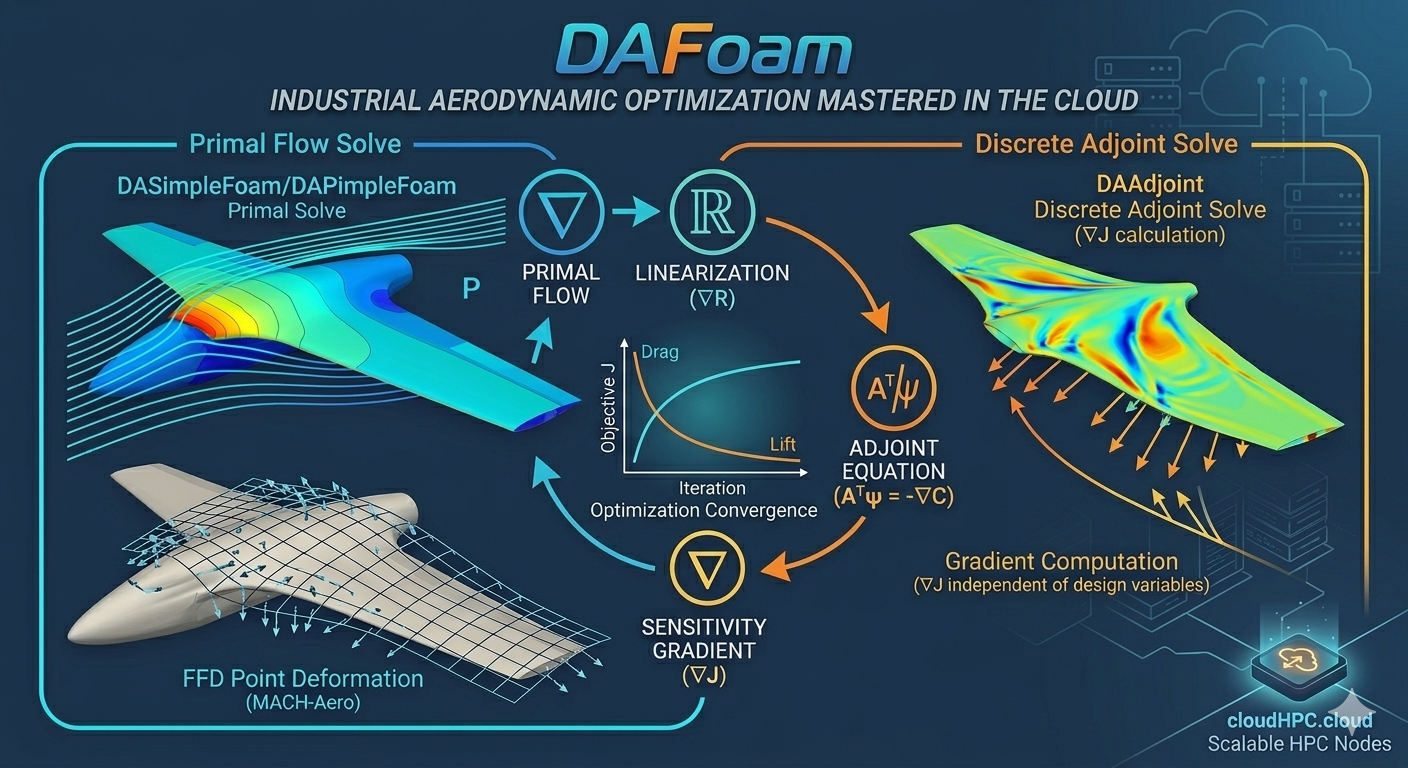
In high-fidelity engineering, traditional shape optimization can feel like a brute-force endeavor. If you are optimizing an aerodynamic component—like an automotive spoiler, a wind turbine blade, or a transonic aircraft wing—using the standard finite-difference approach, your computational cost scales linearly with every new design variable. Introduce 100 design parameters, and you are looking at running 100 individual CFD simulations just to calculate a single gradient step.
This is where DAFoam (Design Analysis and Optimization for OpenFOAM) changes the game. By pairing OpenFOAM with a highly efficient discrete adjoint algorithm, DAFoam makes the computational cost of gradient calculation virtually independent of the number of design variables.
Whether you have 10 or 1,000 design parameters, the derivative calculation takes roughly the same time as a single primal flow solve.
The Discrete Adjoint Advantage
There are two major avenues for adjoint sensitivity calculation: continuous and discrete. DAFoam opts for the discrete adjoint approach, meaning the governing partial differential equations (like the RANS and turbulence equations) are discretized first, and then the exact derivative of the resulting algebraic system is taken.
The mathematical loop follows a rigorous sequence:
- Primal Flow Solution: The script executes the base OpenFOAM equations (such as via
DASimpleFoamorDAPimpleFoam) to resolve the velocity ($U$) and pressure ($p$) fields. - Linearization and Partial Derivatives: DAFoam uses algorithmic differentiation and graph coloring to efficiently construct partial derivative Jacobians of the residuals relative to the flow states and design variables.
- Adjoint Equation Solve: It solves the transposed linear system to compute the adjoint state vectors (the sensitivities).
- Total Derivative Extraction: It combines these states to extract the total derivative of your objective function (e.g., maximizing $L/D$ or minimizing drag) with respect to your geometry.
How to Configure a DAFoam Optimization Case
Configuring a DAFoam case introduces a few unique components on top of your traditional OpenFOAM case structure.
myOptimizationCase/
├── constant/
├── system/
│   ├── controlDict
│   ├── fvSchemes
│   └── fvSolution
├── FFD/
│   └── wingFFD.xyz
└── runScript.py
To bridge the gap between OpenFOAM and numerical optimization frameworks (like OpenMDAO), a DAFoam setup requires three core layers:
1. Standard OpenFOAM Dictionaries
You build your standard polyMesh and set up boundary conditions in your 0, constant, and system directories. However, you must modify your fvSchemes and fvSolution to use DAFoam-specific linear solvers and tolerances tailored to the adjoint calculation. It is strongly recommended to run a vanilla, built-in solver (like simpleFoam) first to guarantee your baseline mesh converges smoothly before deploying the optimization algorithm.
2. Free-Form Deformation (FFD) Box
To morph the geometry seamlessly during optimization without breaking mesh topology, DAFoam utilizes an FFD bounding box. You define a structured control grid (a .xyz Plot3D file) that fully encloses the design surface. When the optimizer shifts an FFD control point, the underlying mesh surface deforms smoothly in response.
3. The Python Orchestration Script (runScript.py)
The orchestration script acts as the master driver. Written in Python, it imports the MACH-Aero or OpenMDAO frameworks, initializes the DAFoam executive wrappers, defines your design variables (e.g., FFD points), and selects the gradient-based optimizer (such as IPOPT or SNOPT).
Overcoming the Hardware Barrier with cloudHPC.cloud
While DAFoam scales beautifully across hundreds of cores, it presents two massive challenges for standard desktop or local workstation hardware: Extreme Memory Consumption and Bulky Post-Processing Data.
The Hardware Rule of Thumb: DAFoam optimization typically requires reserving approximately 2 GB of RAM per 10,000 mesh cells. If you are optimizing a production-level mesh with 15 million cells, you need an infrastructure capable of dedicating 300 GB of high-speed RAM and dozens of nodes to handle the Jacobian matrices.
cloudHPC.cloud removes these computational infrastructure limitations instantly:
- Tailored High-RAM Hardware: Forget “Out of Memory” crashes. Our cloud platform features scalable, massive-memory instances designed specifically to buffer the high-dimensional matrix operations required during discrete adjoint loops.
- Native OpenFOAM Scripting & Cleanups: Running massive parallel optimization loops traditionally leaves thousands of messy
processor*sub-directories scattered across your storage. Our automated orchestration platform executes the simulation cleanly, runs parallel reconstruction (reconstructPar), deletes redundant local domain folders, and delivers a lean, finalized.stlof your optimized geometry ready for immediate validation. - Zero Configuration Overhead: DAFoam relies on a highly interconnected ecosystem of compilers, Python frameworks, and linear algebra libraries. Skip the days of compiling from source code. Our environment comes pre-loaded with optimized OpenFOAM versions and dependency libraries, allowing you to upload your
runScript.pyand start iterating immediately.
Take the Fast Lane to Optimal Design
Aerodynamic efficiency shouldn’t be bottlenecked by how many local CPU cores you can cram into an office workstation. By leveraging the elegant math of the discrete adjoint method via DAFoam and backing it up with the immediate scalability of the cloud, you can discover non-intuitive, ultra-optimized shapes in a fraction of the traditional time.
🚀 Ready to launch your first high-fidelity optimization loop? Sign up and scale your scripts at cloudhpc.cloud.
CloudHPC is a HPC provider to run engineering simulations on the cloud. CloudHPC provides from 1 to 224 vCPUs for each process in several configuration of HPC infrastructure - both multi-thread and multi-core. Current software ranges includes several CAE, CFD, FEA, FEM software among which OpenFOAM, FDS, Blender and several others.
New users benefit of a FREE trial of 300 vCPU/Hours to be used on the platform in order to test the platform, all each features and verify if it is suitable for their needs


