Navigating the Smoke: A Global Guide to CFD and the ASET > RSET regulationin Fire Safety
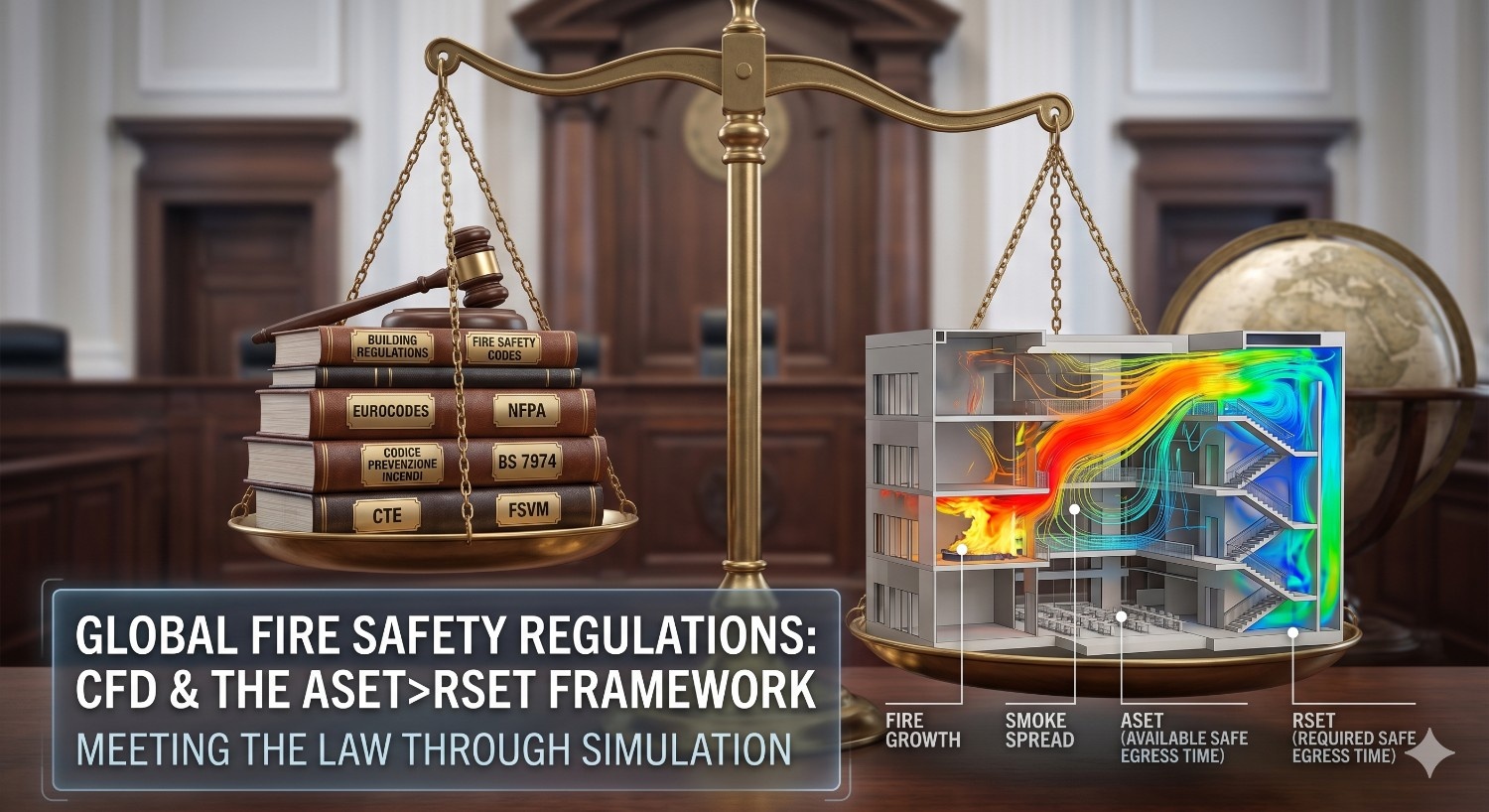
For decades, fire safety engineering was a game of rigid, prescriptive rules. Building codes dictated exact travel distances to exits, specific fire-rating hours for drywall, and strict corridor widths. It was a “one-size-fits-all” approach that worked well for standard office blocks but often stifled modern architectural visions—think sprawling airport terminals, deep underground transit hubs, or sweeping, multi-story atria.
Enter Performance-Based Design (PBD) and Computational Fluid Dynamics (CFD).
Today, engineers can break the prescriptive rules, provided they can mathematically prove their design is just as safe (if not safer). To do this, they rely on CFD software to simulate fire and smoke behavior. But how do authorities worldwide regulate this? Is it a free-for-all, or is there a universal standard?
Let’s dive into how different countries govern advanced fire simulations, and the one universal equation that dictates them all.
The Universal Golden Rule: ASET > RSET
No matter where you are building—from a skyscraper in New York to a shopping mall in Milan—practically every modern building code that allows for CFD relies on one fundamental equation: ASET > RSET.
- ASET (Available Safe Egress Time): This is where CFD comes in. It’s the time from ignition until the environment becomes deadly or untenable (due to toxic smoke, fatal heat, or zero visibility).
- RSET (Required Safe Egress Time): This is calculated using human behavior modeling. It’s the time it takes for the alarms to sound, people to realize what’s happening, and everyone to physically walk out the doors.
If your CFD models prove that ASET is greater than RSET (plus a reasonable margin of safety), your building is deemed safe. The physics remain the same worldwide. What changes, however, is who checks your math and what rulebooks you must follow.
The Global Pioneers: UK, USA, and Australia
Outside of mainland Europe, a few regions have heavily formalized how CFD and the ASET > RSET framework are applied:
- Australia & New Zealand: These nations are arguably the gold standard for PBD. The Australian National Construction Code (NCC) is fundamentally performance-based. Engineers use the Fire Safety Verification Method (FSVM) to directly integrate CFD into the legal approval process.
- The United Kingdom: The UK has long been a pioneer in this space. Engineers rely on the BS 7974 standard, which acts as the holy grail for setting up fire scenarios and proving ASET > RSET to the Building Safety Regulator.
- The United States: In the US, the International Building Code (IBC) allows for “Alternative Methods.” However, because fire safety is governed locally by Authorities Having Jurisdiction (AHJs)—like a local fire marshal—engineers usually follow the SFPE Guidelines. Because AHJs rarely have in-house CFD experts, the US often requires rigorous, third-party peer reviews before a design is approved.
The European Landscape: Harmonized Structures, Local Rules
In the European Union, things get interesting. While the physical structure of a building is governed by harmonized EU standards (the Eurocodes), life safety and evacuation laws remain strictly national. All of the following major EU nations allow CFD and the ASET > RSET approach, but their bureaucratic hurdles vary wildly.
1. Italy: The Strict Legal Code
Italy has one of the most highly formalized frameworks in Europe. The national fire code, the Codice di Prevenzione Incendi, has a dedicated section just for fire engineering. It legally mandates the ASET > RSET approach when breaking prescriptive rules. However, you can’t just run a simulation and hand it in; CFD models are heavily scrutinized by the Vigili del Fuoco (the National Fire Brigade), and the engineer signing off must be registered on a specialized national list.
2. France: The Bureaucratic Gauntlet
France certainly allows CFD, but it is typically reserved for massive, complex projects (like stadiums or complex malls). The legal framework, known as ISI (Ingénierie de la Sécurité Incendie), requires a rigid multi-step audit. Before the local fire brigade (Pompiers) will even look at your ASET > RSET results, your entire methodology must be audited and validated by an independent, state-approved organization (an Organisme Reconnu Compétent).
3. Germany: The Checking Engineers
Because Germany is decentralized, fire codes (Landesbauordnungen) are handled at the state level. When using CFD to prove a fire protection concept (Brandschutzkonzept), engineers turn to the vfdb-Leitfaden—Germany’s premier engineering guide. To get approval, the simulations are usually reviewed by highly specialized, state-certified checking engineers (Prüfingenieure für Brandschutz), ensuring the math holds up to intense scrutiny.
4. The Netherlands: The Principle of Equivalence
The Dutch take a highly pragmatic approach rooted in the Gelijkwaardigheidsbeginsel (the Equivalence Principle) found in their building decree (Bbl). The law dictates the required safety performance; if you don’t want to use standard rules, you simply have to prove your design is “equivalent.” Dutch engineers frequently use CFD to prove equivalence via ASET > RSET, and local municipal authorities are generally highly receptive to this scientific approach.
5. Spain: The Growing Adopter
Spain’s use of performance-based design is growing rapidly. The national building code (Código Técnico de la Edificación, or CTE) explicitly opens the door for “alternative solutions” in Article 5. Because Spain doesn’t have a massive, hyper-specific national CFD guidebook like the UK or Italy, Spanish fire engineers lean heavily on international standards—such as ISO/TR 13387 and SFPE guidelines—to prove their ASET > RSET models to local building control.
The Bottom Line
If you are an architect designing a bold, unconventional building, or a developer trying to maximize usable space, CFD and performance-based fire engineering are your best friends.
The science of fire is universal, and the ASET > RSET approach is the accepted language of safety worldwide. But as any global fire engineer will tell you: while the software computes the same smoke spread in Madrid as it does in Manhattan, navigating the local rulebooks, peer reviews, and fire brigades is an art form all its own.
CloudHPC is a HPC provider to run engineering simulations on the cloud. CloudHPC provides from 1 to 224 vCPUs for each process in several configuration of HPC infrastructure - both multi-thread and multi-core. Current software ranges includes several CAE, CFD, FEA, FEM software among which OpenFOAM, FDS, Blender and several others.
New users benefit of a FREE trial of 300 vCPU/Hours to be used on the platform in order to test the platform, all each features and verify if it is suitable for their needs


