
From CAD to a solver-ready OpenFOAM® case – in the cloud
Ennova imports and repairs your CAD, generates high-quality meshes with real boundary layers, writes the OpenFOAM case for you and lets you explore the results. On cloudHPC it is ready on a remote desktop in your browser, next to the solvers and on the same storage. No installation, no licence server: the licence is charged by the hour, only while you use it.
OpenFOAM is a great solver. Getting a good mesh into it is the hard part.
Most of the time in an OpenFOAM project goes into cleaning CAD, tuning snappyHexMesh layers and editing dictionary files by hand. Ennova was built to remove exactly these steps. It was founded in 2007 by Dr. Michael Hohmeyer, formerly of ICEM CFD and Ansys, and written from scratch as a parallel, client/server application for large industrial assemblies.
Native CAD import – no translation, no lost geometry
Ennova reads CAD through HOOPS Exchange by Tech Soft 3D, so models are opened in their native format instead of being converted to STL first.
- STEP (AP203/214/242), IGES, Parasolid, ACIS and JT
- CATIA V5/V6, Siemens NX, Creo, SolidWorks, Inventor, Solid Edge, Rhino and more
- STL, OBJ and Nastran files for scanned or tessellated geometry
- Dozens or hundreds of parts loaded and prepared at the same time

One-click CAD repair on a mesh topology layer
Manufacturing CAD is rarely watertight. Ennova builds an intermediate mesh topology on top of the original geometry and repairs that layer automatically: stitching, volume detection, imprinting of intersecting bodies, defeaturing and shared-face naming.
- The original CAD is never modified: mesh points stay on the true geometry
- Cleanup targets what the mesh needs, not the whole model
- Large assemblies repaired in minutes, in parallel
- Manual tools are still there when you need full control

The right mesh for each problem
Instead of forcing one grid type on every case, Ennova combines several meshing strategies and produces solver-ready meshes with very little input, including anisotropic, structured-like boundary layers that used to need hours of manual blocking.


OpenFOAM case set-up without editing dictionaries
Ennova’s GUI writes the OpenFOAM case for you – boundary conditions, physics and solver settings – for both the Foundation (openfoam.org) and ESI-OpenCFD (openfoam.com) versions.
- Mesh and case exported in native OpenFOAM format, ready for the cloudHPC OpenFOAM solvers
- The dictionaries stay plain text: you can still open, check and change every file
- CGNS export too, for solvers such as SU2

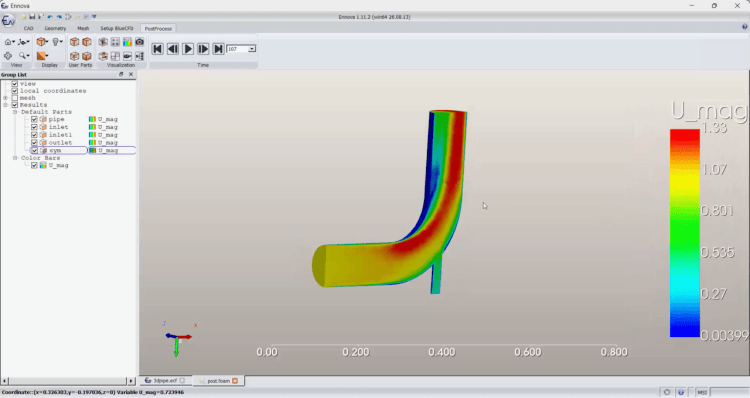
Post-processing built on VTK
The same visualisation technology behind ParaView, in the same interface you used to build the mesh.
- Slices, isosurfaces, clips and thresholds
- Streamlines, surface streamlines and vector plots
- 2D graphs and animations of transient results

What changes in your OpenFOAM workflow
You keep OpenFOAM, its solvers and its zero licence cost for the CFD run. Ennova takes over the steps where most of the engineering hours are lost.
| Step | Typical OpenFOAM workflow | With Ennova on cloudHPC |
|---|---|---|
| Geometry | Export STL from CAD, fix gaps and overlaps in another tool | Native import of 39 CAD formats and automatic repair |
| Meshing | Write blockMeshDict and snappyHexMeshDict, iterate on refinement levels | Choose the mesher that fits the geometry and generate the mesh from the GUI |
| Boundary layers | snappyHexMesh layer addition, often with gaps on complex geometry | Dedicated prism mesher and anisotropic surface meshing for well-resolved near-wall cells |
| Case set-up | Copy a tutorial and edit dictionaries by hand | Boundary conditions and settings defined in the GUI |
| Hardware | Large models limited by your workstation | A cloud desktop with the cores and RAM the model needs |
| Data transfer | Upload meshes of several GB to the cluster | Mesh, solve and post-process on the same cloud storage |
Ennova and OpenFOAM on the same platform
Ennova was designed with a lightweight desktop client and a compute server that runs where the processing power is. cloudHPC gives you exactly that: open Ennova on a cloud desktop sized for your model, then launch OpenFOAM on the same storage when the mesh is ready.
Ready to use
Ennova and every recent openfoam.org and openfoam.com release are pre-installed and maintained. No installation, no licence server to configure.
Pay as you go
The Ennova licence is charged by the hour, only while you are working in it, with no annual lease to buy. The machine is billed per vCPU hour, like every cloudHPC run.
Expert support
The cloudHPC team has worked with OpenFOAM since version 1.5 and can help you set up and run your cases.
Solve with OpenFOAM
Every OpenFOAM release, run in parallel on up to 192 physical cores. OpenFOAM on cloudHPC
Or with SU2
Export the mesh in CGNS and run compressible CFD and adjoint optimisation. SU2 on cloudHPC
Post-process in ParaView
Open large results on a remote desktop, without downloading them. ParaView on cloudHPC
Your first Ennova project in six steps
- Register on cloudHPC and activate your account.
- Upload your CAD files (STEP, IGES, Parasolid, native CAD…) to your storage.
- Start the Ennova desktop on the machine size you need.
- Repair and mesh the geometry with the automatic tools.
- Set up the OpenFOAM case and launch it on cloudHPC.
- Post-process the results in Ennova or ParaView, or download them.
Try Ennova on your own geometry
Create your account, upload a CAD model and go from geometry to a running OpenFOAM case in the cloud.